Archive
Hopeful Writing: Article One: Documents Are Instruments
Most professional documents are completed before they produce an outcome. They reach a point where the writing is acceptable, the structure looks reasonable, and the document can be shared. At that point, work often stops.
The document exists. Work has not moved forward.
A professional document is an instrument. It exists to produce a specific business outcome.
Some documents move work forward quickly. Others generate discussion without resolution. The difference reflects how the document is structured and what it enables the reader to do.
What documents are for
Documents support business outcomes such as making a decision, reaching alignment, or initiating execution. Background, context, and analysis support those outcomes.
Writers often focus on describing the situation in detail. Readers focus on what the document enables.
That difference shows up during review. Questions like “What are we being asked to do?” or “Is this meant for approval?” are signals that the function of the document is unclear.
When the intended outcome is not explicit, readers infer one. Different readers infer different outcomes. Teams enter review with different assumptions about the document’s purpose.
Review slows. Alignment fragments. Decisions are delayed.
Purpose needs to be explicit, and up front
Many documents open by describing what they contain. They explain what the system does, what the initiative includes, or what problem space is being explored. That context is useful.
Readers decide how to engage early. They decide whether to skim, where to focus, and how closely to evaluate what follows. That evaluation depends on purpose.
A clear purpose statement defines the role of the document, the action expected from the reader, and the standard used to evaluate it.
When purpose appears late, readers form an initial interpretation and then revise it. That introduces re-reading, inconsistent evaluation, and delay.
Clear purpose saves time.
Focus on outcomes
Effective documents make the path to an outcome visible.
They state the decision, the recommendation, the tradeoffs, and the next steps. They identify ownership. They define what success looks like.
This allows the reader to evaluate once, with the right context.
Teams move faster when the requested action is clear, ownership is defined, and success is measurable. Disagreement centers on tradeoffs rather than interpretation.
Viewed this way, purpose serves the organization. It ensures the document contributes to the work.
Evaluating your own document
Before sharing a document, pause and ask: What outcome does this document support? What action is required from the reader? What happens after this document is read?
If those answers are not clear near the beginning, the document will struggle in review regardless of the quality of the writing elsewhere.
Addressing that gap is usually more effective than refining sentences or adding detail.
Why this comes first
Documents fail before language becomes the limiting factor.
Word choice and tone affect readability. Purpose and structure determine whether the document can be evaluated at all.
Once the document is treated as an instrument, structure and emphasis follow from the outcome it is meant to produce.
That shift changes how documents behave in practice. Work moves forward with less friction.
Hopeful Writing is about writing documents that work—the kind that lead to clear decisions, shared understanding, and effective execution. It presents practical guidance grounded in expert feedback across real business documents. The result is a systematic approach to writing that prioritizes usefulness over polish.
Introducing The Hopeful Writing Series
As an engineer, as an engineering manager, and as a former Doc Bar Raiser with Amazon, I have a well-defined perspective on what makes a quality document, the process and thinking that goes into that outcome, and a clear vision of what I want my documents to achieve.
I’m sharing that with you.
Documents have the power to shape decisions
In most organizations, written documents are the primary way decisions are made, communicated, and revisited.
They capture:
- the problem
- the options
- the reasoning
- the recommendation
- and the plan for execution
They answer:
- What decision is required
- What is being recommended
- What happens next
- What happens if no action is taken
They become the shared reference point for people who were not in the same conversation or who engage with the decision later. The quality of the document directly affects the quality of the decision. Clear structure reduces interpretation. Specific language reduces ambiguity. Evidence allows evaluation.
When these are present, decisions move forward with less friction. When they are not, the cost shows up in delay, misalignment, and rework.
What this series covers
In this series, I share my perspective on approaches that produce a quality document. We focus on how documents behave in real environments:
- how purpose determines structure
- how structure shapes interpretation
- how language expresses ownership
- how evidence supports evaluation
- how recommendation and implementation affect outcomes
- how documents are reviewed in practice
Documents influence how organizations think and act. A well-structured document allows a reader to evaluate a decision once, with the right context. A poorly structured document requires the reader to interpret intent before they can evaluate it. The difference between those states determines how quickly work moves forward.
Let’s make that difference visible and repeatable.
Hopeful Writing is about writing documents that work—the kind that lead to clear decisions, shared understanding, and effective execution. It presents practical guidance grounded in expert feedback across real business documents. The result is a systematic approach to writing that prioritizes usefulness over polish.
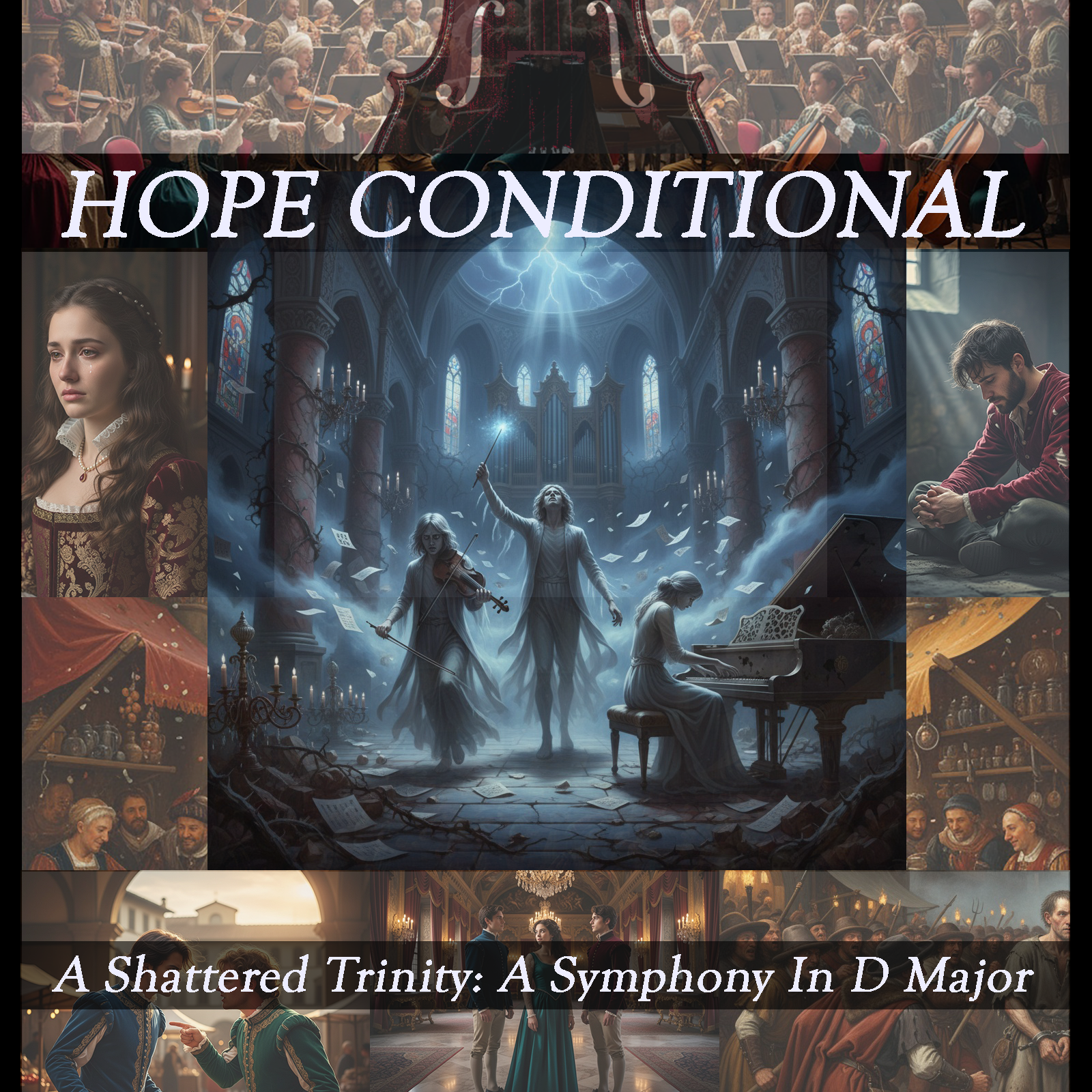
A Shattered Trinity: A Symphony In D Major
I’ve always wanted to write a full symphony. I like the structures, I like the idea of having to compose for such a large group of instruments, and I like the flexibility I get beyond my more guitar based influences, although I also enjoy writing songs in that mode. So one day I asked ChatGPT to describe for me an example structure for a Baroque style symphony. That outline led to my most recent work.
There were song structures I’d never heard of, tempos I’d never composed in, time signatures I’d never thought to attempt despite my foray into odd meter on nearly every album I’ve published. Any other time I’ve tried to start an idea like this I’ve experienced writer’s block trying to come up with compelling themes, especially considering I didn’t quite understand how to use themes in classical music in the first place. But I recalled a simple bit of melody from Servings Of Sadness that had come to me as I sang it to myself while making lunch, and decided if it was compelling enough to be sung, it would be a compelling enough start. That six note motif became the Motto, the base, for the set of themes I crafted for my symphony, including a theme each for the two protagonists, a Love Theme, a Battle theme, and more.
I found many of the structures limiting at first; fugues in particular with their predefined key changes were difficult. On occasion I would get stuck, and when I couldn’t get myself out, I’d take some advice from ChatGPT on potential solutions. Eventually, the story became evident: two young men, friends in fact, fall for the same young woman in a Renaissance era city filled with festivals and joy. The city itself is a character, an observer, to a tragic tale of love and loss.
Three concertos and an orchestral suite later, A Shattered Trinity is born.
You can learn more about this album here.
Available on Spotify, YouTube, and Amazon Music.
Be welcome and true.