About A Shattered Trinity: A Symphony In D Major
Released: April 2026
Introduction
One of my goals has always been to write a symphony, or perhaps more than one. For my first, I chose to construct a Baroque style symphony, and for the most part, conformed to its structures in terms of piece choice, piece structure, tempo, and key changes. At times I found the structure limiting; at other times I welcomed the forced perspective and how it made me think about harmonies and instruments, and how it made me leverage multiple techniques during theme development.
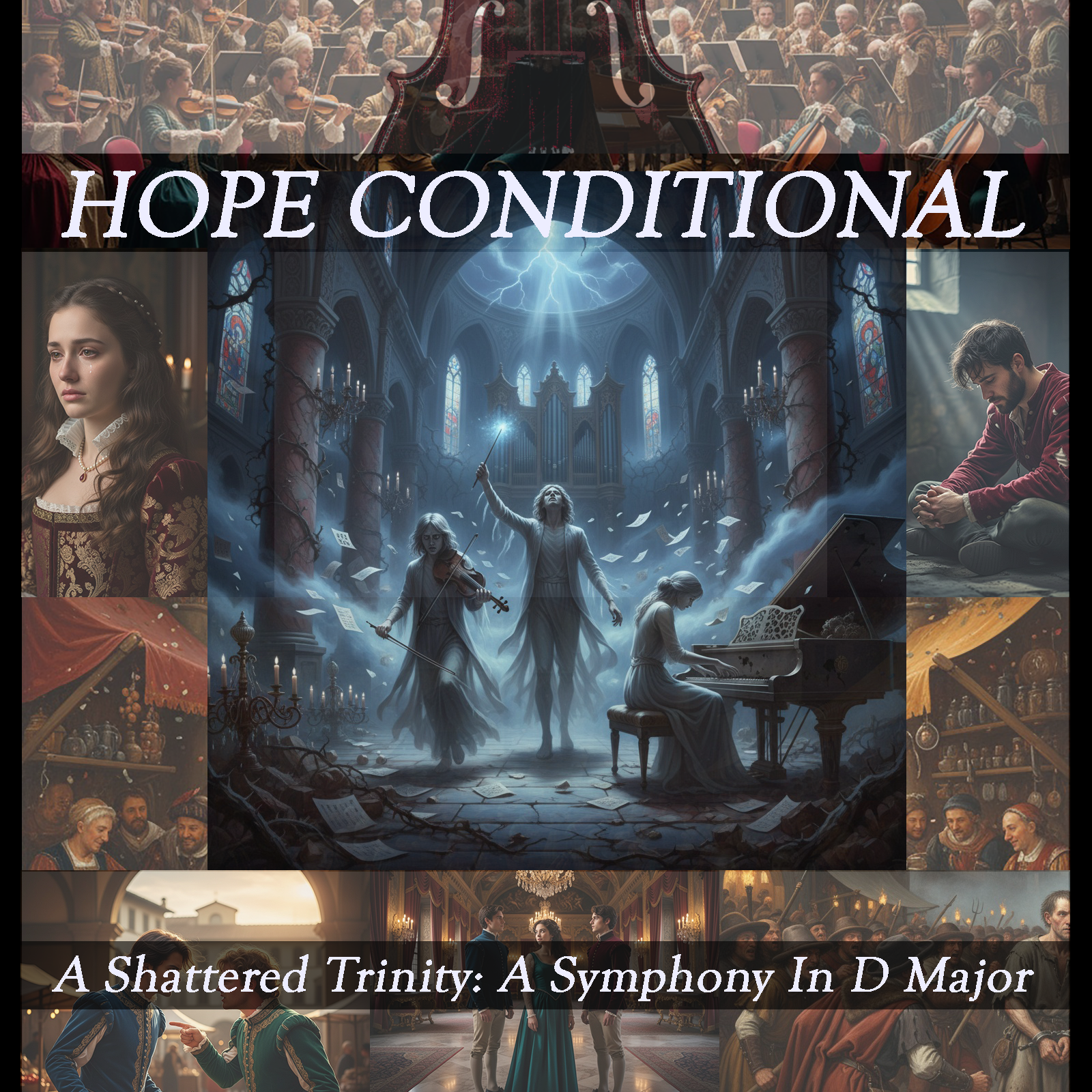
A Shattered Trinity tells the tale of a doomed love triangle, from character and setting introduction through to the demise of the young men and the scandal that rocked the city’s denizens. It contains four major sections, three concertos and an orchestral suite.
As a learning experience, I chose to leverage AI for ideation but not for composing specifically. ChatGPT was able to provide historical references, outlines of pieces and how they might be approached, and occasionally help me out of tricky situations. I cover much of that in an earlier blog post. Other than that, I did not use AI to compose this symphony.
Available on Spotify, YouTube, and Amazon Music.
Interestingly, Apple Music doesn’t accept what appears to be classical music for whatever reason.
Themes Explored
The symphony and its accompanying technical requirements were the primary exploration for this work. I did come up with a specific set of themes for this musically, but the story itself is fairly straightforward. By the time I was done composing, I had a Motto, David’s Theme, Erik’s Theme, a Love Theme, a Battle Theme, a New Beginnings Theme, with multiple variations of each as those ideas were developed throughout.
Specific Techniques Explored
Because of my desire to write a “traditional” symphony, I was fairly circumspect in terms of stepping outside some of the more rigid key structures and modal expectations. That said, in particular in episodes within the commonly used ritornello structure, I took liberties, throwing in Locrian modes, tritone key changes, downward key changes, and some of my other favorite techniques, while staying true to the spirit of the overall traditional structure.
I was unused to taking mottos and themes and using them repeatedly across pieces. At times I had to take a step back and think about how to keep this from becoming stale. I settled on quite a bit of rhythmic and accent variation; at one point the main motto is shifted 1 beat early, using the opening eighth notes as a lead in to a measure rather than opening the measure. In another I varied note length when the time signatures shifted. It was difficult at times but overall I’m happy with how I was able to reuse themes without feeling like I was repeating myself too much.
Finally, I couldn’t help myself: at one point over the general objection of ChatGPT, I introduced a polyrhythmic section in 11/8 over a 6/8 time signature to represent the scandal and chaos of discovery. Hopefully I’ve hidden it well; ChatGPT was insistent that the piece needed to be a dance and the 6/8 feel needed to be maintained at all costs.
Songs
THREE FRIENDS
The opening concerto, Three Friends, introduces the characters, settings, and primary themes of the symphony. David and Erik, the violin and the viola, are two young citizens of a renaissance era city; Amelia, the oboe, is their friend, who becomes more than that to them. While the city, the trumpet, doesn’t fully enter as a primary instrument until the orchestral suite’s overture, the first piece’s introduction, and a dance that closes the concerto help to set the city’s mood and its place in the overall story.
David And Erik
Style: Allegro Ritornello Key(s): D, A, E Lydian, G Lydian, Bm, D Time Signature(s): 4/4
The opening ritornello to both the symphony as well as the concerto introduces all of the major components of the work. After opening with a fanfare of brass and winds, the Motto of the piece arrives in D major, the symphony’s key center. The first episode introduces David’s theme, before a brief return to the Motto in A. Episode 2 has three distinct sections, with the first two introduces pieces of the Love theme in Lydian. The third section of Episode 2 shifts to Bm and introduces Erik’s theme, foreshadowing his eventual demise. A return to the Motto in D ends this introductory piece.
The Light Of Amelia
Style: Adagio Ternary (ABA) Key(s): Bm, C Lydian Time Signature(s): 3/4
The character of Amelia arrives, viewed through the eyes of David and Erik. The Love theme is introduced in the opening moments of the work, and returns to close out the piece, but presented in a minor key, as ultimately the situation faces certain doom. With the theme established, David and Erik add their own interpretation of the Motto as they warm to Amelia’s charms. Amelia herself eventually arrives at 1:48 as the key shifts from minor to Lydian, and her radiance raises the mood.
Shall We Dance
Style: Allegro Binary (AABB) Key(s): D, A, Bm, G Time Signature(s): 6/8
The trio take turns dancing at a city festival. The Dance theme is introduced, reinforced by call and response between the trio’s voices and the remaining orchestra. The piece completes the introduction of the main characters and setting, bringing in the city’s tones and instruments to voice the overall dance atmosphere.
DEVOTIONS DIVIDED
The symphony’s second concerto, Devotions Divided, centers on the two friends realizing what is happening, confessing to the truth, and then confronting the inevitable, before both attempting to move on and return to normal.
The Realization
Style: Ritornello Fugue Key(s): Bm, F#m, G, D, Bb, Em, Am, Bm Time Signature(s): 4/4
The Realization sees both friends slowly understanding the situation. Erik’s viola leads with the fugue’s subject, and David’s violin answers. A cello rounds out the three main voices of the piece.
In addition, the concept of three influences the fugue’s structure; the subject, answer, and countersubjects are all 3 bars long instead of the typical 4 that one would expect in 4/4 time. This pattern is echoed during the episodes that develop each, maintaining a rhythmic flow that feels uncomfortable. A tritone key change from the 2nd episode to the fugue’s reentry adds to the discomfort, shifting from Bb to Em, before the 3rd episode continues in Am, one step down from the previous episode.
Confessional
Style: Largo Ternary (ABCA), Fugue Key(s): G, Em, Gm Time Signature(s): 4/4
Each friend confesses their feelings to Amelia, with the violin and viola both taking turns interpreting the Love theme, infusing voicings from their own themes. After an initial confession in the piece’s A section, the oboe joins as the three voices shift to a fugue in Em for the B section. The C section shifts to Gm, up a minor third, and reinterprets the fugue’s themes by introducing a major 2nd chord to the progression, adding tension to the setting with uncharacteristic brightness. A descending eighth note rhythmic figure adds movement to the fugue’s reinterpretation, before returning to the Love theme in the original G major to close the piece.
In a symphony full of slower moving, melodic pieces, this is one of my favorites.
Confrontation
Style: Vivace Ritornello Key(s): Bm, G Locrian, D, A, Fm, Em, F# Phrygian Time Signature(s): 6/8
In Confrontation, the two friends engage in a battle, if not of physical, of verbal proportions, as their competition threatens to tear them apart. David’s violin and Erik’s viola argue in short bursts while the city’s trumpet observes and attempts to defuse.
Between different episodes of the argument, a ritornello outlines the tension in the piece, featuring the French horn, the trombone, and the bassoon. The low tones reinforce the mood, and the music further expands that by including a key shift at 1:25 from Bm to G Locrian, which also introduces the Battle Theme in its completeness that the two voices have been hinting at since the beginning of the piece. The battle them then shifts through different keys in each episode as the argument descends into chaos and then stabilizing as each episode ends.
CHAINS OF TOMORROW
Chains Of Tomorrow is the symphony’s third concerto. The confessions and confrontations are over, and the trio attempt to move on with their lives, concentrating on new beginnings. Alas, the echoes of their affection and the masks they choose to put in place are not sufficient to keep them apart.
The concerto shifts key center to the dominant, G Major, from D Major, and introduces new themes and variations to signify the shift towards the future. Sadly, the three eventually follow their hearts, failing to shake off the chains of their situation.
New Beginnings
Style: Allegro Ritornello Key(s): G, Em, C Lydian, Gb Time Signature(s): 6/8
The backdrop of the city returns, the ritornello based in horns but lacking the brightness of trumpets. The mood is light, and dancing is encouraged. In the episodes, the main voices branch out into new themes, trying new things, seeking a new beginning after the confrontation. Foreshadowing the future, the final ritornello shifts the key center down a half step to Gb major after spending time in Amelia’s signature C Lydian, offset by echoes of trumpets amongst the horn melody as all the voices join in.
Echoes Of Light
Style: Andante (ABA) Key(s): Em, C, G Time Signature(s): 4/4
This slow, airy work attempts to set a mood, only bringing in clear melodies at the end. Until that time arrives, echoes of other themes, placed as snippets or segments, move in and out, at times in their original keys, leading to intentional dissonance as emotion regains its hold on the trio. The lack of clear path and structure is also intentional, as is the slow pacing. The introductory Fmajb5 chord increases the sense of unease before resolving to F major, and then leading into Em as the key center. That same chord selection ends the piece, allowing for the work to feel unresolved as it opens and closes on variations of the dominant 7 chord. Loftier voices such as the flute are featured as well. To provide a sense of uplift, the end progression transitions from Em to G major, and introduces other borrowed chords, such as following a Cmaj7 with a B/D# rather than B minor.
This is one the pieces where I intended to do something very specific, build something that focused on tone and ambience rather than melody. I like the piece overall, but will leave it up to others to determine if it succeeded or not.
Behind The Masks
Style: Allegro Ritornello Key(s): G, Eb Mixolydian, Bm, C Lydian Time Signature(s): 4/4
The characters put on a brave face as turmoil rages behind the masks of the trio. Eventually they all participate in the lively ritornello after each of their own episodes. Erik’s episode is darker then the other two voices, an additional foreshadowing of the character’s fate. Amelia attempts to comfort them all, but even though the other two voices join her, comfort is fleeting.
DOWNFALL
Downfall is the orchestral suite. In six movements, the masks crack, the characters rediscover each other, and tragedy ensues amidst scandal, peril, and confinement.
Stories At The Shoppe
Style: Allegro Overture (ABA) Key(s): Dm, D, Bm Time Signature(s): 4/4
The overture for our suite. Initially we are in D minor rather than D major, maintaining a sense of foreboding as this chapter of the story is introduced. Lower tones, including violas, punctuate the atmosphere; the basses spend little time, if any, on the root note. The progression features chromatic tonal changes, Dm/A -> Dm9/Bb -> Edim/G -> Dm -> Em7 -> Gm7 -> Bb, executing three times before settling on an E half diminished 11, followed by an A7 -> A, before settling into a triumphant D major fanfare that introduces the Motto with city wide trumpets.
From there, all four voices are presented as equals for the first time, and we weave through variations of our themes as we explore the city and its marketplace, the primary setting for our scandal and ultimate finale of our symphony.
Reacquaintance
Style: Allemande (AABB) Key(s): D, A Time Signature(s): 4/4
The lively marketplace brings our three together again, rekindling old flames. David and Erik trade variations of their theme as they make their case to Amelia; Amelia responds with caution, and the city eventually joins in her plea. The plight, with no good solution, eventually soars until all four voices join again, before a last plea from the city fades at the end.
Whispers In The City
Style: Courante (ABABA) Key(s): D, Bm Time Signature(s): 6/8
Technically the most controversial, if you will, of the works in this symphony. This is intended to be a dance, and ChatGPT was insistent it remain so. But, this piece is about the citizens finally realizing the scandal in their midst and sounding the proverbial alarm.
Initially the city attempts to maintain the festive atmosphere. Once the secret is exposed, the episode features a variation of the Battle theme voiced by each of the three main characters, intermingled with the city’s trumpet and horns, over a polyrhythmic progression. The melodies and the tonal changes are in 11/8, while the underlying bass and cello’s rhythmic pulse remain in 6/8.
Another attempt to stay festive follows, but the woodwinds bring chaos in the upper registers with 11ths and 13ths over the otherwise happy progression. As that closes, the Battle themes return, but more stable as the city comes to terms, with the melodies and tonal changes aligned with 6/8. A final clarion is sounded, and then the Battle theme continues over the city’s desperate attempts to return to happiness as the piece closes.
The Tragedy Of Erik
Style: Sarabande (AABA) Key(s): Bm, Bbm Time Signature(s): 3/4
I wrote this song early in the process because I wanted to establish the somber overtones in Erik’s theme. This is one of my favorites, and sounds very much like I expected when I conceived it. It features one of my favorite techniques: a hanging note from the viola at the end of the B section that changes meaning with the key change underneath. The note, an A#, is the third of an F# major chord that closes the B section, in the key of Bm. As the note hangs, the key shifts down a half step to Bb, and as an Eb major chord come in, the A# becomes the fifth of that chord before continuing through Erik’s theme in the new key.
Both David and Amelia share in this lament at different times, saddened by the role they have played in the resulting tragedy.
The Accusation Of David
Style: Gavotte (AABA) Key(s): D, Bm Time Signature(s): 2/2
This was a difficult piece to write. It is brief, and in a time signature I had never written in before. I relied heavily on the lower tones to give the piece it’s plodding 2/2 feel.
Once again, the city finds its festive mood interrupted. David argues against the accusations with a variant of the Battle theme while the trumpets continually sound alarms. In the end, David is sentenced, his battle against the city’s accusations falling on deaf ears.
Dances Echo In Dungeons
Style: Fugue Gigue Key(s): D, A, G, Bm, E, A Time Signature(s): 12/8
In mocking fashion, the voices of the city embrace the Motto and the Love theme, and present them in a joyous fugal counterpoint; the city dances while the memory of Erik’s demise fades and David is forced to endure the happy echoes from a cell as the story draws to a close.
Be welcome and true.