Archive
A Prompt Response – You’ve Been Warned
What was the last live performance you saw?
You’ve been warned!
The last live performance I saw was in New York City just over a year ago, at a club called the Warsaw in Brooklyn. I was extremely excited to be in NYC at the same time as this band, my favorite for well over the last year. I could go on and on about them if I chose…
The Warning.
To quote their introduction:
“We’re three sisters from Monterrey, México. We love rock, we love music.”
The Warning draw strength and power from a lifetime of sisterhood and music. The Mexico-born sister trio—Daniela “Dany” [guitar, lead vocals, piano], Paulina “Pau” [drums, vocals, piano], and Alejandra “Ale” Villarreal [bass, piano, backing vocals]—have logged thousands of miles on the road, generated hundreds of millions of streams, and left countless fans in awe. They initially made waves with a string of independent releases, paving the way for their acclaimed 2022 full-length offering ERROR. Between performing alongside Muse, Foo Fighters, Guns N’ Roses, Royal Blood, The Pretty Reckless, and Three Days Grace, the band ignited MTV’s Extended Play Stage at the 2023 MTV VMAs. Representative of their cultural impact, Pepsi even notably chose them as the face of Pepsi Black in Mexico. Now, The Warning embrace their destiny on their 2024 full-length album, Keep Me Fed [LAVA/Republic Records] out on June 28th.
And they are incredible. Their YouTube channel is full of videos and conversations and is brimming with commentary from the Warning Army.
If you do nothing else, watch their concert at the Pepsi in Mexico City…it’s epic.
They were every bit as good live at the show I saw. Can’t recommend enough.
This post is one of many in my responses to random prompts surfaced by the application that tracks my website statistics, as well as any others I encounter.
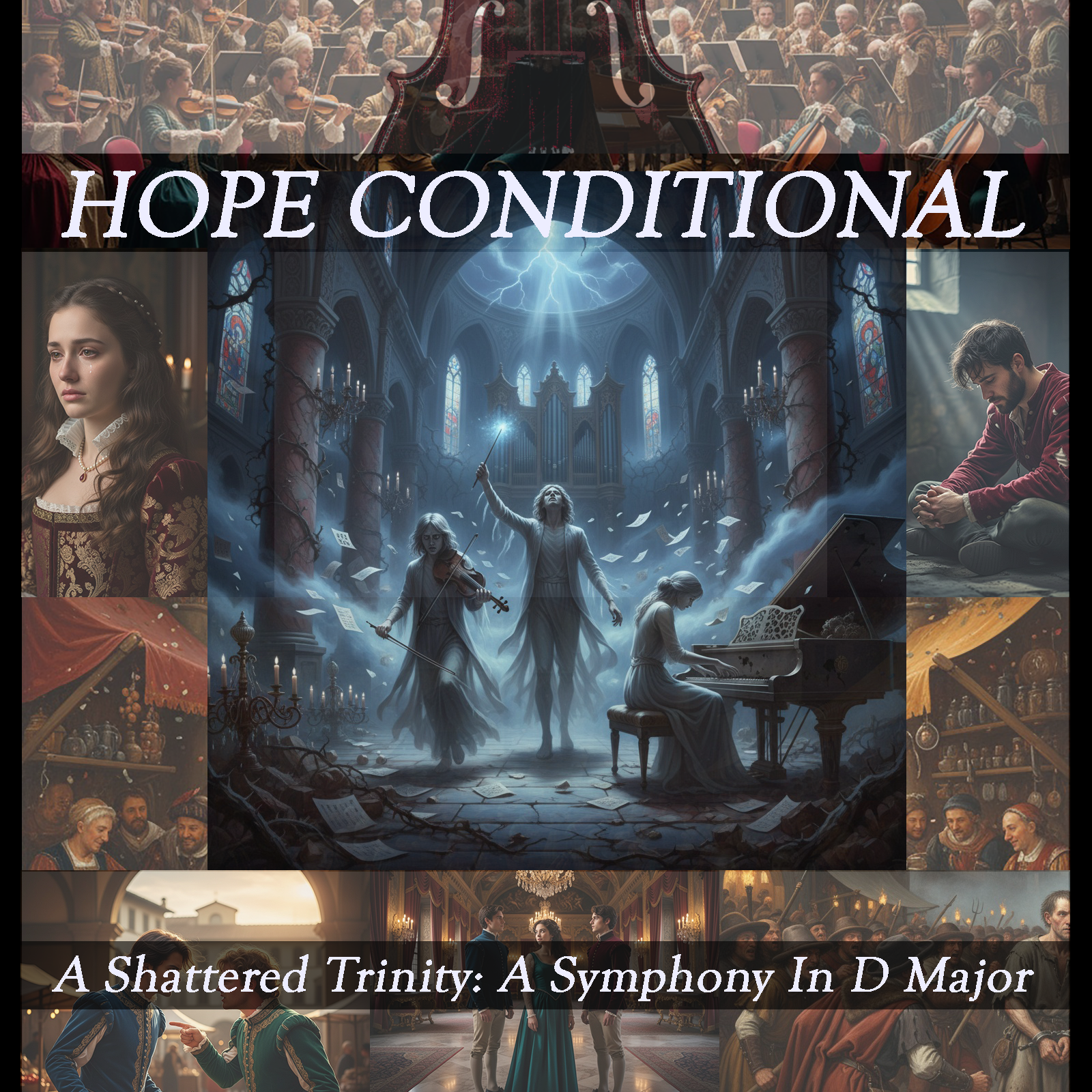
A Shattered Trinity: A Symphony In D Major
I’ve always wanted to write a full symphony. I like the structures, I like the idea of having to compose for such a large group of instruments, and I like the flexibility I get beyond my more guitar based influences, although I also enjoy writing songs in that mode. So one day I asked ChatGPT to describe for me an example structure for a Baroque style symphony. That outline led to my most recent work.
There were song structures I’d never heard of, tempos I’d never composed in, time signatures I’d never thought to attempt despite my foray into odd meter on nearly every album I’ve published. Any other time I’ve tried to start an idea like this I’ve experienced writer’s block trying to come up with compelling themes, especially considering I didn’t quite understand how to use themes in classical music in the first place. But I recalled a simple bit of melody from Servings Of Sadness that had come to me as I sang it to myself while making lunch, and decided if it was compelling enough to be sung, it would be a compelling enough start. That six note motif became the Motto, the base, for the set of themes I crafted for my symphony, including a theme each for the two protagonists, a Love Theme, a Battle theme, and more.
I found many of the structures limiting at first; fugues in particular with their predefined key changes were difficult. On occasion I would get stuck, and when I couldn’t get myself out, I’d take some advice from ChatGPT on potential solutions. Eventually, the story became evident: two young men, friends in fact, fall for the same young woman in a Renaissance era city filled with festivals and joy. The city itself is a character, an observer, to a tragic tale of love and loss.
Three concertos and an orchestral suite later, A Shattered Trinity is born.
You can learn more about this album here.
Available on Spotify, YouTube, and Amazon Music.
Learning Music Theory Online
In a sense, I’ve been self-taught most of my life. I taught myself how to code, and built a successful technology career before returning to get my degree. When I did that, I cracked books galore. The internet was relatively new and online resources such as Stack Overflow either did not exist or were in their infancy.
Late in high school, as high schoolers sometimes do, some friends of mine and I decided to put together a band. I picked up a cheap bass at the local music store and we learned a few songs, but no one really stuck with it after a few “practices”.
But sometimes opportunity strikes, and my Aunt had a cover band that played local venues, and they needed a bass player. I got the gig after a basic audition.
Now I really needed to learn how to play bass. Luckily, the band had most of their songs charted out on paper, so I literally printed them all out and charted out chord progressions and potential passing tones. Most of the material was standard 3- and 4-chord country based songs, so there weren’t many hard songs to learn.
But my actual learning came from MTV. I spent hours upon hours with my bass in front of the TV, playing with every song that came on. Back then, all MTV did was play music, and that was my training ground. The first song I ever played in such a session is Stranger In A Strange Land by Iron Maiden, a song that remains a favorite of mine.
And other than books that was the only real option.
Today, though, the learning resources are endless, and I have taken advantage of them not for my playing, but for my composing.
There are a ton of YouTube videos and other resources dedicated to becoming a better bass player. Scott Devine and Mark J. Smith are favorites of mine. I’ve learned a ton about bass technique, but also about how to think about bass lines.
But the biggest impact on my understanding of music and my ability to compose has been the incredible volume of high quality content on YouTube about music theory and how it can be applied to both modern music as well as classical music. I’ve never been able to learn from books, I learn by watching. I learned more watching my guitar player’s hands in my early bands than I ever did from a book.
I’m subscribed to over 20 channels dedicated to music theory. I often use them as inspiration. One of my favorite time signatures today is 11/8; one of the techniques I love to employ is polyrhythm, making odd time signatures feel like straightforward time signatures rhythmically. A video of legendary drummer Simon Phillips playing in 33/8 led to the song On A Failure To Dance, which is mostly in the same time signature. I’ve written several songs, and parts of songs, in Locrian mode, considered the “unlistenable” mode. That challenge came from another video.
The point is, if you want to learn, there is no shortage of high quality content online. The sky’s the limit if you want to learn.
As part of my own music content, I’ve outlined some specific channels here. They are well worth your time if you wish to learn.
Be welcome and true.