About The Devengar Cycle: A Symphony In C Minor
Released: November 2026
Introduction
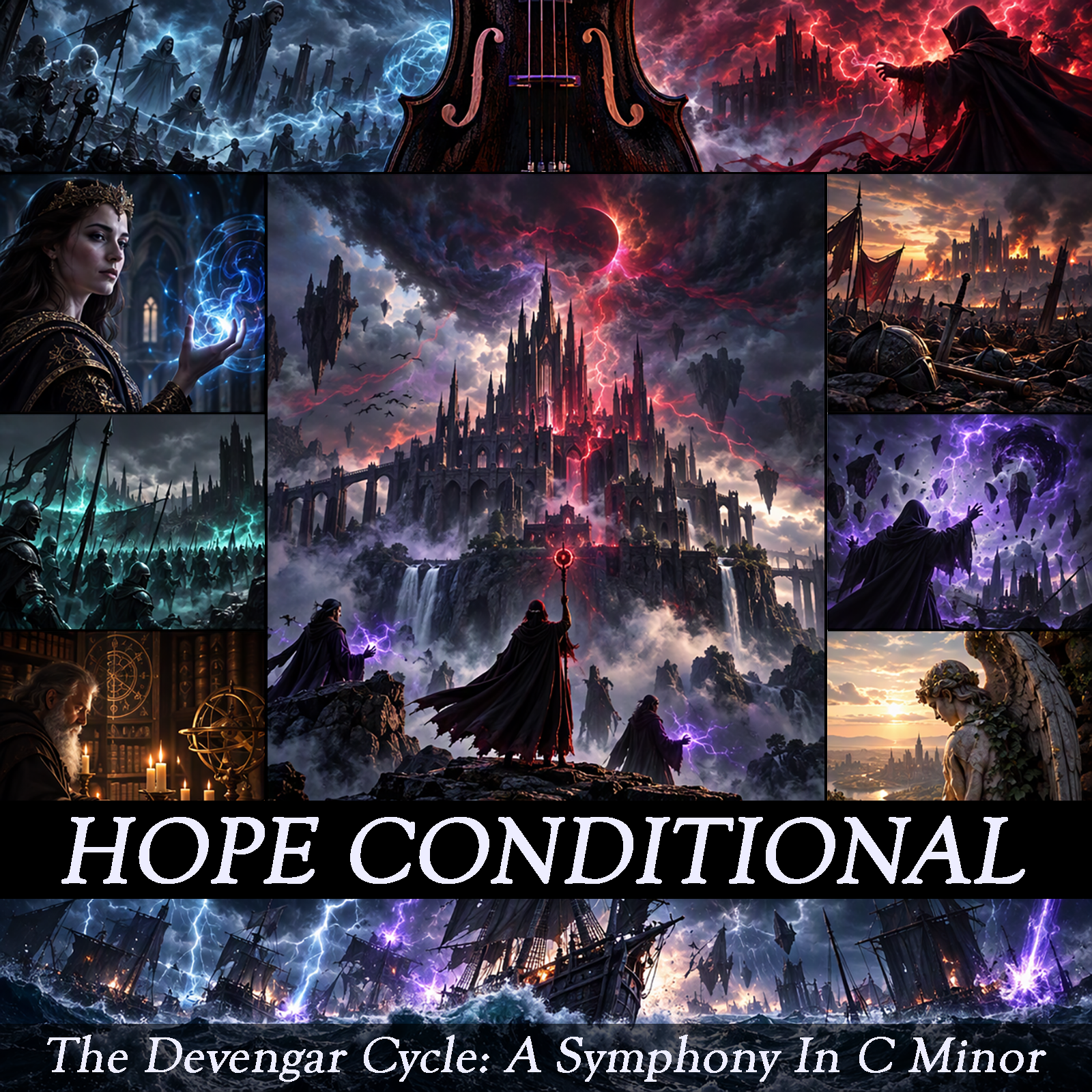
After A Shattered Trinity, I wanted to write something that went a completely different direction. That symphony was Baroque, built on ritornellos, fugues, and dances with their forms fixed in advance. The Devengar Cycle goes the other way. It is through-composed and Wagner-influenced, and the music carries the story, the world, and the psychology all at once. There are five acts and twenty-six movements, and they all follow one narrative.
What’s interesting is where the idea comes from; years and years ago I had written what was intended to be the introductory chapter to a book series based on this idea that “magic” was simply a way to control electromagnetism; “mind control” was just learning how to control the electrical impulses in the brain. In a society without technology, this would seem to be powerful sorcery, and due to the electrical nature of that sorcery, the magicians would come to be known as “Lights”. They would be ranked, with a “Light Of The Sky” being the master of those magicians.
That chapter became the narrative outline for the symphony. I was not prepared for it to balloon to a two hour and eight minute work, but the story was deep and held many moments for music to decorate.
The story begins in an ancient empire governed by the Lights. It follows the ambush of their Empress by a rogue sorcerer named Nathrak, a hunt across the sea aboard the warship Sunsdown, a landing on a black-sanded island, and a final confrontation. The survivors then come home to mourn and deal with the aftermath. The Lights, the Empress, the city, and the villain are all themes, and the themes behave like characters. They return, change, interact, and even fight each other.
Available on Spotify, YouTube, and Amazon Music.
Interestingly, Apple Music doesn’t accept what appears to be classical music for whatever reason.
Themes Explored
The cycle is built from families of material that are introduced early and return transformed.
Devengar is the world theme, and underlies all of the other themes in various forms. There are Five Lights on the Council, and they each get a signature interval, with one falling a fourth, another falling a third, and so on. The theme of Evil begins alongside the Council of Lights, and Nathrak’s theme is foreshadowed in Forbidden Power; Nathrak’s theme is staccato and punctuated by semi-tone transitions. Elianna, the Empress is represented with warm melancholia. Kabisera is the capital city, introduced in a grand march within the palace halls. Themes of Fear, Goodbye, and Sunsdown (a rhythmic motif in the bass) mark the pursuit, the funeral, and the warship. Mystery, Battle, and Hero arrive in Act III and carry through to the end as powers contend for the future of their world.
Specific Techniques Explored
Withheld thirds. The cycle opens on an Eb9 chord with no third and an Ab sus4 with no third. Clear thirds are saved for moments of revelation.
Meter as story. Calm movements stay in 4/4, and unstable moments go unusual. The most extreme is Do Not, which alternates 15/16 with 3/4, 4/4, and 5/4. Mind Control opens in 13/8. Aftershock is built on a 7/4 backbone, and Ocean Battle Electric moves between 6/8, 3/8, 4/4, and 5/8.
Modes as color. Modes are used as emotional shading more than key centers. Phrygian and Locrian modes dot areas of threat, while Dorian and Lydian appear in the warmer, more ceremonial places.
Tritone pairs. Ocean Battle Electric sets Ab minor against an E pedal, a tritone apart. The Ambush of the Empress pairs D against Ab. I used tritone key changes a lot in A Shattered Trinity, and this is the same idea on a larger scale without resorting to similar changes.
A movement without a key. Shockwave has no key, in particular no real bass voicing. It’s a stack of chord voicings, and its pitches don’t fit any seven-note mode well, as the point of the work is battle chaos.
A fugue under a melody. In Final Council, a complete fugue is buried beneath the Lights’ melody.
Tempo as drama. Works shift tempo many different times throughout the symphony.
Songs
Act I
Act I introduces several themes along with the first few characters of the symphony. The world Devengar, its Council of sorcery, its Empress, and the growing threat all emerge as the story begins.
Dawn Over Devengar
Style: Introductory Tableau, Through-Composed Key(s): Eb, Ab, F, Cm Time Signature(s): 4/4
The cycle begins with ambiguity; we’re in Eb major, the companion key to Cm, and we’ll get to Cm eventually, but the chord is a 9th with no third. The first transition is to Ab major, with a sus4 and no third. We don’t bring the third in until we hit F major, the main “triumphant” key signature throughout the work. Near the end, as doom begins to seep in, we hit Cm, with an interesting landing an Abm, the minor 6th chord, before the work comes to an end.
The Council Of Light
Style: Processional with Faction Episodes Key(s): Fm, Bb Mixolydian, C Mixolydian Time Signature(s): 4/4, 7/4
We meet the Five Lights, each identified by a two-note intervallic theme. They argue over perceived threats, and the harmonic shifts follow the factions. A stretch of 7/4 near the middle makes the debate feel less certain and more troublesome as echoes of evil surround them.
The Empress
Style: Lyric Character Piece, Ternary Key(s): Eb Lydian, Bb, Dm, A Time Signature(s): 6/8
A portrait of Empress Elianna, a former Light and the anchor of the realm. The tonal center sits between Eb and Bb, and the Lydian color gives her theme a slightly melancholy glow.
Forbidden Power
Style: Scherzando Occult Intermezzo Key(s): Ab Phrygian, G Phrygian, B minor, Ab Time Signature(s): 3/4, 2/4, 3/8, 4/4 and 5/4
In dark places, some Lights are experimenting with possession and other evil deeds. Nathrak’s theme arrives in pieces as foreshadowing. The overall semi-tone pulse back and forth across varying time signatures draw an unsettling picture of a descent into violence, highlighted by the climbing diminished run that closes both the piece and Act I.
Act II
Act II sees the action begin. After a grand ceremony, Nathrak ambushes and kills our Empress, then flees the Great Hall. After honoring the Empress, the Lights vow to chase Nathrak down and end his evil ways.
The Halls Of Kabisera
Style: Grand Ceremonial March Key(s): F, D Dorian Time Signature(s): 4/4
Kabisera, the capital and spiritual center of Devengar. This is the Hall at its peak, shortly before disaster. The city’s theme appears as the march opens, and Elianna’s theme joins for the “announcements at the great hall.”
The Ambush Of The Empress
Style: Dramatic Episode, Through-Composed Key(s): Dm, D Locrian, G# Phrygian Time Signature(s): 4/4, 5/4, 3/4, 2/4
Nathrak ambushes Elianna, as both themes battle. Elianna’s is initially hesitant, as if sensing her approaching enemy. The first of several Dbmaj7b5 to Cm7 transitions happen in the context of this battle, which ends with Elianna’s final anguished scream. A shift to G# Phrygian follows as Nathrak slowly slinks away, his heartbeat raging in his ears even as hers beats its last.
Flight To The Wharf
Style: Pursuit, Moto Perpetuo Key(s): Gm, Gb Lydian Time Signature(s): 7/8, 4/4
A frantic chase as the Fear theme is introduced. The chase proves futile though, as the transition to Lydian announces Nathrak’s escape as if it indicates a false sense of hope.
Funeral Imperial
Style: Recitative-Like Lament Key(s): Eb, G Dorian Time Signature(s): 4/4
A sorrowful Goodbye to our Empress as Kabisera mourns their leader. The piece closes on a slow melody filled with pride and honor for what she meant to them, while ultimately landing on a melancholy Gm chord.
Vow Of Pursuit
Style: Rising Vow, Overture-Like Key(s): Dm, Bm Time Signature(s): 4/4
Our hero gathers a small company of Lights and commissions the warship Sunsdown to hunt Nathrak. Quartal harmonies drive the piece from above. The warship’s theme appears is more rhythm than harmony or melody as it surges across the sea in pursuit.
ACT III
The first battles arrive as the warship approaches an island of volcanic, lifeless sand. The fleeing ship of Nathrak is in sight, and the first exchange of magical warfare leaves Sunsdown wounded and threatened with destruction.
Black Shores
Style: Atmospheric Prelude Key(s): Cm Time Signature(s): 4/4
The uncertainty of the approaching battle overcomes the crew. The Mystery theme makes an appearance, and the slow shifting tempo and the reappearance of Db against the Cm key makes this a very unsettling time.
Battle Stations
Style: Mariner’s March, Build-Up Key(s): Gm, G Phrygian Time Signature(s): 4/4, 2/4
The crew prepares to fight. The Battle theme is featured here, both rhythmically and harmonically. The underlying bass rhythm is meant to invoke an oncoming train that the crew can’t stop.
Shockwave
Style: Explosion Scene, Chaos and Silence Key(s): None Time Signature(s): 4/4, 3/4, 5/4
A magical blast rocks the ship. This is the cycle’s clearest non-modal movement, built from stacked minor sevenths and minor sixths, with the themes folded directly into the voices; there is no key or key center, and the themes are scattered and incomplete as chaos erupts.
Ware The Reef
Style: Dialogue and Argument Key(s): Abm, Dbm, Fm Time Signature(s): 4/4
The crew debates what to do as the ship nears the island’s reef. Recovery from the initial magical attack is uncertain; disagreement is severe. The Hero theme is introduced, as they begin to exert their influence and take charge of the situation.
Ocean Battle Electric
Style: Central Battle Set-Piece, Symphonic Development Key(s): C Dorian, F# Phrygian, Ab Dorian, Abm, Gm, Cm Time Signature(s): 6/8, 3/8, 4/4, 5/8
Our hero and villian come face to face in their first true battle. The Hero and Nathrak themes interact throughout. The key centers walk around the circle, with a long tritone stretch of Ab tonalities against E bass tones in the middle. There are sections of chaos, calm, with each theme gaining and then losing ground. Here the raised sixth (A natural in Cm) within the Hero theme’s second part is crucial as it signifies hope under adversity.
Aftershock
Style: Aftershock and Salvation Episode Key(s): Gb Lydian, Am Time Signature(s): 7/4, 6/4, 4/4
One of the more sentimental pieces in the symphony as the situation becomes desperate, then stabilizes. A 7/4 pulse mirrors the rocking of the giant waves, and the tonalities wander from minor to Lydian to a closing lament for those that have just perished.
Do Not
Style: Transition, Threat Resurfaces Key(s): Cm, F, Db Lydian Time Signature(s): 15/16, 3/4, 4/4, 5/4
The threat returns and the ship is slowly rocking as Nathrak forbids them to come closer. The time signature changes emphasize the ship’s listing movements, while the brass-fueled melodies echo the crew’s growing resilience and desire to see this through.
ACT IV
Act IV continues to steam towards our tonal C Minor center as the heroes catch and ultimately confront their Empress’s assassin on the side of a smoking volcano, braving possession and even death to bring justice to Devengar.
The Landing
Style: Static, Sparse Tableau Key(s): F Dorian, E Phrygian, C Phrygian Time Signature(s): 4/4
The crew makes landfall amid threat and uncertainty. They are deliberately quiet, deliberately lacking melody. The long voicings and Phrygian color create hostility and unease.
Ashes And Emptiness
Style: Uneasy March Key(s): B Phrygian, Cm Time Signature(s): 5/4, 7/4, 6/4, 4/4
The group climbs toward the smoking cone through ash and toxic fumes. Their steps are uncertain, as their fears of ambush and attack prove to be well-founded.
Mind Control
Style: Fantasia, Hallucination Key(s): Em, Fm Time Signature(s): 13/8, 4/4, 5/8, 6/8, 6/4
Nathrak attempts to take over the heroes’ minds. The meter changes constantly, and the movement ends with echoing heartbeats before landing on a large “everything” chord, which contains every note of the chromatic scale, to signify the impact of such evil on the heroes as many fall.
Destiny Of Darkness
Style: Confrontation, Chorale Against Solo Key(s): Cm, Ebm, C Phrygian Time Signature(s): 4/4, 3/4, 11/8
Chaos as evil nears their triumph. It opens on the “everything” chord slowly dwindling into our home key atop a driving rhythm. Polyrhythmic structures are everywhere as 5/4 note groupings sit uneasily atop 4/4. The occasional moment of heroism interrupts the darkness, but ultimately falls back into the depths of evil.
Light Of The Sky
Style: Final Battle, Multi-Section Key(s): Dm, Gm, Ebm, Eb Dorian, C, C#m, F Time Signature(s): 4/4
The final battle, which opens on Nathrak claiming victory before our heroes rally. The polyrhythms continue harmonically. Eventually Nathrak falls, and the Hero slowly realizes he has survived. The piece ends with themes echoing our heroes as well as Kabisera and Devengar.
ACT V
The battle is over, but the healing has just begun. After a voyage home and more grieving the lost, Devengar turns towards an uncertain future, not knowing if evil has been truly defeated.
Homecoming
Style: Slow March Key(s): F, Bb Time Signature(s): 4/4
The survivors rejoin the scarred Sunsdown and set course for home. Low drones carry the movement, as voices shift from modality to modality, echoing the exhaustion the heroes experience as they head home.
Kabisera In Mourning
Style: Funeral March, Passacaglia Key(s): Dm, Eb harmonic minor, G Dorian Time Signature(s): 6/8
The capital mourns. A steady repeating bass motif echoes the uncertain sadness. Eventually the work soars into shared grief paired with a sense of pride in the actions of our heroes.
Final Council
Style: Argument Scherzo and Trio Key(s): E Phrygian, G, Bb, F, A, Am, Bb Time Signature(s): 3/4, 4/4
The Lights debate how to deal with possession and mistrust within their own order after all that has happened. In one of the few times I stuck to form, a Fugue structure outlines the Lights’ conversation, adding a sense of continuity to relationships that to date have been almost acrimonious.
Somber Triumph
Style: Dual Character Piece Key(s): Gm, Bb Lydian, A Dorian Time Signature(s): 4/4, 3/4, 5/4
Reflective and unresolved, this piece alternates between enduring grief and concern and looking ahead to the future after victory.
The War For Devengar
Style: Finale-Coda, Cyclic Recall Key(s): Eb, Bb Mixolydian, Ab, Dm Time Signature(s): 4/4, 6/4
The finale recalls the opening in a darker form. The real enduring threat is the idea of possession itself, and the world of Devengar has been changed forever. It ends on a similar minor 6th chord of the minor key, showing that even though there has been triumph, it is unclear if they’ve truly won.
Be welcome and true.