Archive
What I Would Look For In A Cover Letter
Recently I wrote about how my approach to cover letters changed during my recent job search. As part of that, I was asked what I would look for in a cover letter.
What I Look For
You’ve put the effort into writing a cover letter. Let’s make sure it delivers on that effort.
- Why You Want The Position
Clearly, everyone seeking a position would like a job for some reason. In this troubled job market, people need to be less selective. That’s understandable. But if you can come up with a compelling narrative for why you are interested, that’s a plus. I have a deep background in business marketplace search engines. If I am applying for a position oriented on search, I open with that relevant experience and my interest in those types of systems.
- Why You Will Succeed In The Position
These first three points are all similar, but have different framing. Take this opportunity to articulate why you will be successful if we hire you. It could be your experience, it could be your excitement about what the position will work on, it could be your drive and ability to learn, but make a case that you are going to succeed.
- What Are Your Relevant Strengths
You have strengths. You have experience. Not all of it will be addressable in depth on your resume. Take this opportunity to include a sentence or two for strengths that are directly relevant and will be helped by expansion. This is not for checklist items such as how much experience you have. For example, when positions mention strong communication or strength in mentorship, I use this opportunity to surface my bar raising roles at Amazon for both document writing as well as engineering manager onboarding.
- How Do You Communicate
Most resumes don’t have the space or the context to provide a chance to showcase communication skills. A cover letter provides a chance for you to show how you communicate, to surface your personality. I would not exclusively use AI for this reason; a seasoned communicator will know when you use it and will know it’s not representative of you.
- You Know Who We Are And What We Do
Hopefully you are interested enough to know who we are and what we do. Take this opportunity to tell the hiring manager what about the company resonates with you, and show that you are willing to take some initiative as you target your job search.
- A High Level Sense Of Who You Are
Inject some of yourself into your cover letter, so that the hiring manager can get a read on who you are. Hopefully my cover letter reads the way I want to come across in interviews, as a calm, confident, competent candidate.
What I Don’t Look For
There are things that I will not look for, or hold against a candidate. I don’t believe in mythical checklists or hidden gates that candidates need to be aware of. I’m a big fan of transparency, and won’t reject a candidate just because they aren’t aware of my preferences, especially if those preferences aren’t publicized.
- Personalization
I have seen suggestions that candidates should deeply research the personnel responsible for the position, including the recruiter and hiring manager. I have seen suggestions that cover letters that aren’t addressed to a specific person should be rejected.
Many positions don’t have this information, and even if they did, that has no bearing on whether or not the candidate is qualified for the position and falls into the category of hidden checklist. I address my cover letter as “Dear Hiring Manager”, and that’s acceptable in my view.
- Deep Research
It’s great if you understand what the position requires, have a general awareness of what the company does, and a general awareness of what the company values are should the company articulate them publicly. I don’t expect more than that.
- Appropriate AI Usage
AIs are writing cover letters a lot nowadays, along with other artifacts involved in the hiring process. I can generally glean whether or not writing was done with AI. If I feel like the entire thing is AI generated, that might give me pause; but I encourage candidates to use AI to clean up their writing and narratives.
- Perfect Writing Mechanics
I’ve been a Doc Bar Raiser for Amazon. I know how to evaluate writing mechanics. I can spot typos and other grammatical errors. I’ve also been in meetings where wonderful ideas or highly deserving promotion documents were picked apart due to writing quality. If a document is poorly written, that can be a red flag. But small typos and grammar errors, I’m inclined to ignore.
- Complete Qualification Match
Much like a screening interview, a cover letter is an introduction. The resume is the appropriate place to evaluate qualification matches; a cover letter should summarize why the candidate feels a resume review or a screening interview is in the best interest of both parties.
On the Bay Review: so far ahead of our time.
Most who know me know I’m not always much for nostalgia, but lately I’ve been wondering just what would have happened if I had been able to technically solve a problem back in 2001 given what I know now, and what technologies are available now. As an author, a poet, and an advocate of independent publishing, I do sometimes wonder if the Bay Review, an online journal I started with a friend of mine back in 2000, was simply too far ahead of its time.
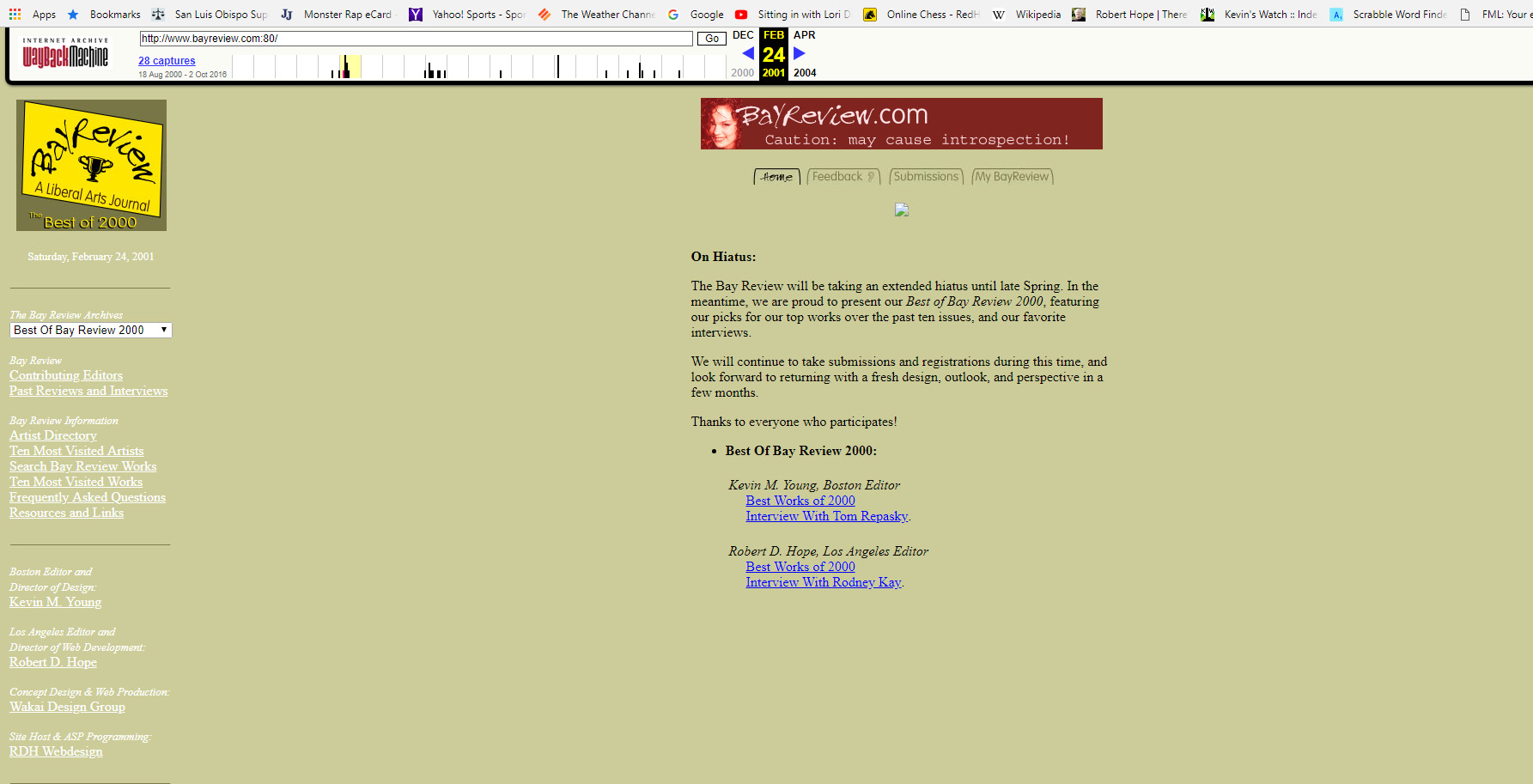
In early 2000 I was just starting to get into web development. I had achieved my dream of becoming a programmer with PropertyFirst.com, an online commercial real estate platform that would eventually become LoopNet and be my professional home for close to 17 years. I was also writing a lot and wanted to see what we could do to publish people like myself online. At the time, independent publishing didn’t exist outside of large companies who would charge thousands of dollars to create print books, and there was little to no online publication available to independent authors. The idea of publishing content online was in its infancy.
So a friend of mine and I put up a website called the Bay Review. It was intended to gather submissions from various people via email, and then we’d put them into HTML format and publish them on the site every month. It took off much more than we would have expected, and ultimately we had to shut it down after six months for a variety of reasons that seem easily solvable today, close to 17 years later.
First, the success. Within 5 months we were getting submissions at a rate of close to 20 a day. This was back when Google and Paid Search and SEM and SEO weren’t even a thing. This happened with Yahoo! Search and word of mouth and viral goodness. By April of 2001 we were getting more than 400 submissions a month and it became impossible to keep up. I was converting submissions to HTML by hand because the technology to automatically convert Word documents to HTML did not yet exist in a way that would survive its use. Basically, any attempt to automate Office 2000 died spectacularly on first execution. This was the biggest first failure, and when it was apparent keeping up with our success was going to be a full time job, we had no recourse other than to shut it down so we could stay at our real full time jobs.
And that was because of the 2nd problem; we had no clean way to monetize. A paid subscription might have been worthwhile but seemed unlikely, as this was the early days of starting to get everything for free, and although we had 400+ submissions, our reader traffic was not yet that high, and would not support enough memberships to make it worth our while. We had the same sorts of conversations about monetization strategies you see now in the marketplace, including the possibility of introducing micropayments, or charging readers pennies for pages read as they went through the website. Sadly, though, we had no time to build such a solution under the onslaught we found ourselves.
And the trolls! Or so we would call them now. My friend and I instituted a family friendly standard, meaning no adult content. I had to hand screen or read 400 submissions on top of the conversion, and when we accidentally let a f-bomb through, the message boards lit up with complaints about other works that had been rejected. Instead of an understanding of the difficulty we faced and the effort we put in, we were called out for failure.
It was an impossible situation to maintain, and we closed down.
With all that, I regret many times that we did not have the technology then to do what systems do now, whether its automatic document conversion or automated content screening. We might be sitting here today as one of the pioneers of online publishing.
Long live the Bay Review.
On Meeting Your Muse (2014 Elohim-fest), and the blessings of the Watch
We all have our inspirations, the people who bring out the best of us. I have managed to do a lot of things over the course of my life that might be unexpected were you to meet me for the first time. My forays into music and writing are two of them.
I can still remember the defining moments that drove me to play music: When I was 14 and picked up a guitar for the first time I was told I would never be a guitar player because I did not have the “look”; In my sophomore year of high school, the first time I saw KISS live on video, I was hooked on bass and hooked on the epic coolness that is Gene Simmons on stage and thought, if I could not be a guitar player, perhaps I could be a bass player. In my senior year of high school I started up a fledgling rock band and began to learn bass to MTV videos, specifically to the galloping awesomeness of Iron Maiden’s Steve Harris.
But the one thing that got me absolutely driven to play was my first glimpse of the brilliance that is George Lynch. Although he is a guitar player, and I am a bass player who can also play guitar, his music is what drove me to play. I consider him a muse, one of my “heroes”. Someday I hope to simply shake his hand and tell him how much of a difference he made in my life.
I mention George, and the intensity of my love for his work, as well as the positive and negative events that led to what I consider to be a successful music career, to put context into the story of this event. To a lesser degree professionally, but perhaps to a larger degree personally, I have a similar muse in the writing world. In many ways his work is so powerful, so amazing, that at times it seems overwhelming for me to even engage as an author; I’ve written tons of poetry but I find it difficult to write actual stories because I just know it can never be that good. I would love to one day be considered a good author, and in the last few years I’ve tried to write short stories and had difficulties with finding the “voice” of various characters as I work through story ideas.
One way that I’ve managed to get the writing juices flowing is through an online community known as “Kevin’s Watch”. I joined the Watch in 2008 and have nearly 2,000 posts there. You can check it out here when you have the time and if you are so inclined. It’s simply an awesome community of people with like interests and who have actually become friends. And it’s not in the Facebook friends kind of way, either. We all have an interest in our favorite fantasy author, but on top of that we discuss other novels, other artists, tell jokes, and even rant at each other in one of the more civil (allegedly) political forums, our very own “Think Tank”. The group has turned out a few anthologies of short stories and I’ve used that as well as some internal discussion forums to try to move my writing forward.
All of which is background for an event that happened last weekend in Albuquerque, New Mexico, the home of my favorite author, Stephen R. Donaldson. He is the author of the Series That Changed Me, the incomparable Chronicles of Thomas Covenant, the Unbeliever. They are epic fantasy in a way that Tolkien is not, driven by strong characterization and heroic characters that grip you with their passion and dedication to what is right. In the midst of this amazing world, Thomas Covenant stands as an embodiment of all that could be wrong with the universe, an anti-hero who is driven to criminal actions by his inability to believe in a fantasy world filled with the purity of untainted love and beauty. There is no more vivid world to lose yourself in, no more vivid story to immerse yourself in. A Second and Last Chronicles have followed, along with Mordant’s Need, a two-part series that is well worth reading, and the Gap Sequence, a five volume brutal examination of man’s basest desires and depravity that builds for three and half books to a gripping climax that leaves you turning page after page after page, an absolutely transcendent work of ever-increasing intensity that doesn’t let up for more than a thousand pages. And there are books of short stories as well as a mystery series.
Stephen R. Donaldson’s website
For a different perspective on this event, visit Lynne Cantwell’s fantastic blog at Hearth/Myth
For the last decade, after the release of a book, Mr. Donaldson has agreed to meet with fans of his, mostly from Kevin’s Watch, for a dinner and interactive Q&A session. Dubbed “Elohim-fest” after a race of characters that Thomas Covenant encounters, this “meet and greet” has reached its fourth incarnation, with over 40 of us attending from as far away as Australia and Finland. I myself attended for the first time, with two goals. One was to merely shake the man’s hand and acknowledge everything he’s done for me; the other was to ask him one of those “how do you do what you do” questions, specifically around the struggles I’ve had with voice in my stories. In poetry, meter and rhyme can dictate voice; in prose, I still struggled with it.
Asking My Question
So I asked him my question, something on the order of, “How do you write dialogue that sounds real to your readers, and that doesn’t sound like something you yourself would say?”
I can’t really tell you what he said to be honest, because as he answered the question, he maintained eye contact with me the whole time, and just to have him know for that few minutes that I existed was more than enough! It was beyond words.
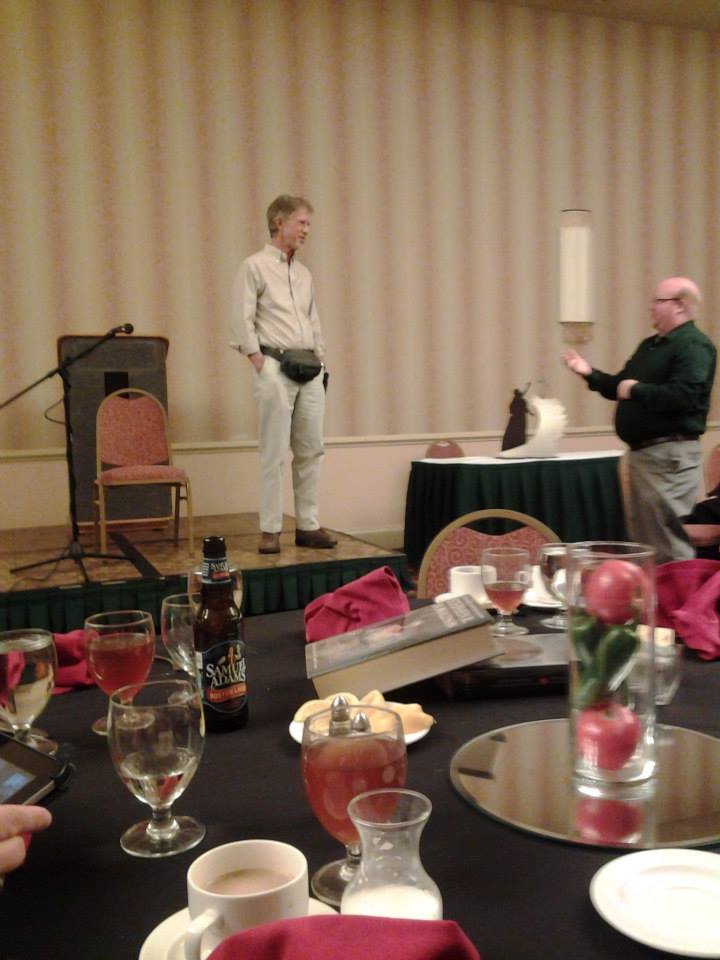
Stephen R. Donaldson
That in itself was amazing. To actually meet a hero of mine. How often do people really get to do that?
But the weekend was so much more than that, mostly because Kevin’s Watch, as a community beyond your everyday internet community, made it that. I’m fairly socially awkward around people until I get to know them, and to be honest, a small part of me was dreading dropping myself into an environment with people I’d only met online. Back in 1997 I was part of the first “internet chat rooms” at Yahoo! and had some disastrous “meet and greet” events in those days. Plus I just don’t usually believe that what I have to say is going to be of much interest to others. But Danlo (the host of the event and the man we all owe much thanks to, along with his lovely wife) made everyone feel at home at a gathering the night before the event, and I completely felt as if I’d known these people all my life, which in a way, I sort of have, given my now 6 years as a member of the Watch. I had so many amazing conversations and talked to people from all over the world in ways that I would not have done without the Watch. I made some unexpected friends as well. I can’t wait for the next one when they have it…as much for another chance to sit in a room with my favorite author as to simply talk about writing with people who are engaged.
So, the moral of the story, I suppose, is to go and meet your muses if you can. And when you do, I hope that you will meet a bunch of wonderful people who are on the same journey, and be able to count them as friends. It’s a great feeling and one that is hard to describe, and even harder to replicate.
Be welcome and true.
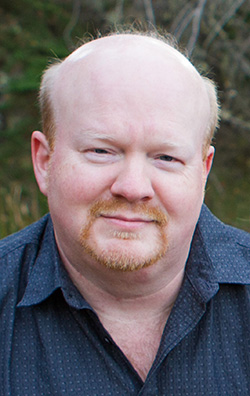
 Rob Hope