Some Typical Instrumentation Choices
I use some predictable choices in the instrumentation of my songs to accomplish very specific goals.
Percussion Choices
I pick out specific sets of orchestral percussion for specific reasons across most of my catalog, when the orchestra in scope.
- Bells
- Bells are often used to accent melodies and chord changes. I find they add shimmer at the high end, and can impose a sense of foreboding at the low end. These are almost always single notes chosen with intention. Maggie’s Theme uses this technique.
- Xylophone / Vibraphone
- In many instances, in particular in songs where I’d like a punchier melody, I will echo some if not all of the melody on a xylophone. It brings a percussion and an ability to cut through that helps with melodic clarity. The Fall Of Isabel is a good example of this, where the xylophone adds impact to the piano melody. So is On A Failure To Dance, where the xylophone echoes the outline of the acoustic guitar and bass track.
- Timpani
- Timpanis are fantastic for crescendos or tuned tom choices when orchestra is in scope as well.
Acoustic Guitar Patches
As I’ve mentioned, I’m not the best guitar player. I will definitely record my acoustic guitar chords live, but some of the more complex picking parts I can’t execute for a variety of reasons. I end up mapping them out as tracks and I’ve found an excellent patch within Reason that sounds reasonable enough to accomplish what I need. I’ve seen articles on line where people kind of push back on this due to having to map each string, but that’s exactly what I do. I write a guide track, then I map each string to its own patch, primarily to allow me to ring strings against each other just like an actual guitar would allow. While this does take time in Notion and Noteflight, the result is worth it.
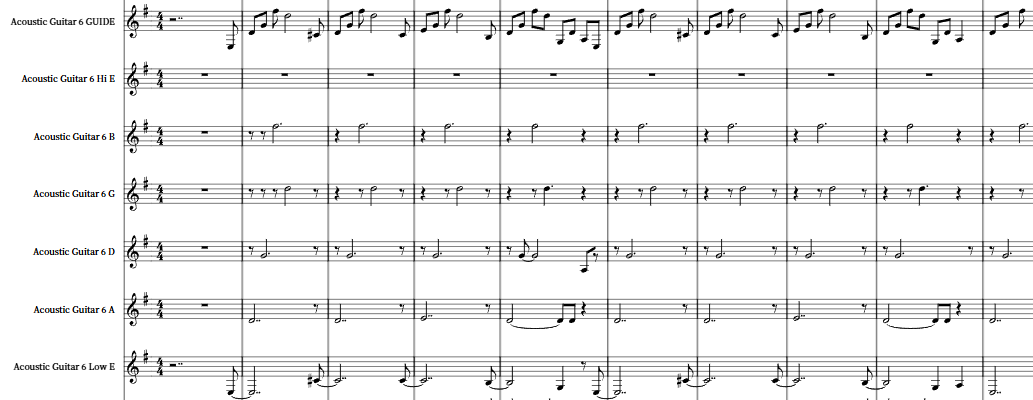
Multi-String Bass and Acoustic Guitars
I create 12 string acoustic guitars by mapping out twelve strings instead of six. I first map the part out as a 6 string, and then I’ll copy the 6 strings so I have 12, and then raise the 4 bottom strings up one octave, to replicate the tuning on a 12 string guitar. You can experience this on Dawn.
I do a similar thing with a 12 string bass. Dug Pinnick of King’s X and KXM uses a 12 string bass on specific songs, and I’ve adopted it within my parts. I map out a bass guitar part, then copy it two additional times, and bring first up one octave, and the second up two octaves, achieving a natural sounding multi string bass. You can hear this clearly on the intro to On Stories Of Fantasy.
Other Orchestral Choices
There are a few other instruments I will occasionally bring in depending on the tonality or musicality of the piece.
- The Theremin
- Whenever I need a sense of spaceness or otherworldliness, I’ll bring in a Theremin. You might recognize the instrument from the theme for the Original Star Trek series.
- Baritone
- Occasionally when I have a broad set of notes and I want brass, I’ll bring a baritone to help span the depth from trumpet to tuba.
- English Horn
- A woodwind instrument, I’ll often pair this with the oboe when I’m not feeling that a clarinet sounds correct.
Be welcome and true.
 Rob Hope