My Writing Process
Conception and Inspiration
There are many things that will spawn a musical idea for me.
- Emotion
Especially in my early musical career, I was compelled to write. It is one of the key ways I express myself, a critical outlet for whatever I am experiencing. That has definitely changed and softened over the years, but generally speaking I can take some emotional state and create something that fits it, at least for me.
- Something I’ve read
I’ve read a ton of books and poems and stories. I often will consider one as an inspiration, such as with On Kevin’s Watch, inspired by The Chronicles of Thomas Covenant, or the entire Zombie Chronicles, based on something my son wrote.
- Something I’ve experienced
Life experiences often inspire music, such as On Road Trips or Dawn. Often something that has just happened can find its way out of you and into your art just by the nature of who you are.
- A new musical concept
A video teaching about 6th chords inspired Extended Melancholia. An instructional video on counterpoint techniques in classical music led to half of the construction of Numericoncerto. A video on how hard it is to write in Locrian mode has inspired at least a half dozen of my songs, or parts of those songs, and was a driving force in my desire to take these concepts, use them, and then make them seem as natural as I possibly could.
- Something I’ve heard
One of my earliest inspirations musically was the chord progression in the chorus of Two Out Of Three Ain’t Bad by Meat Loaf and Jim Steinman. When I hear unique things like that, I invariably end up taking them apart, trying to understand them, and then using variations of those elements in songs of my own.
- An intellectual idea
Reaction to current news and events or basic day to day things can often lead to inspiration, as in Election Day, and On The Distraction Of Sudoku. Although the concepts are dry, attempting to translate them into meaningful music can be enjoyable, as in the use of the numbers 1 to 9 in the percussion parts of Sudoku. I will often try to use things like song position to inform composition, as when I used quartal harmony (based on 4ths) in the 4th movement of The Barochial School Sextet.
- Boredom
When I am not intellectually engaged, picking up a guitar is one of the things I am most likely to do, and from there, ideas of their own will flow.
Often, songs are a result of a combination of one or more of these.
Early Drafts
Once I start an idea, I typically dump it in basic form, even just chord progressions, into Noteflight. Noteflight is a perfectly capable browser-based music notation system. I will park these ideas so that I can come back to them later, and because Noteflight is browser-based, I can do this from anywhere if I choose. I’ve started songs at the airport, in a doctor’s office, pretty much anywhere. While it can be difficult, you can even do rudimentary changes on your phone.
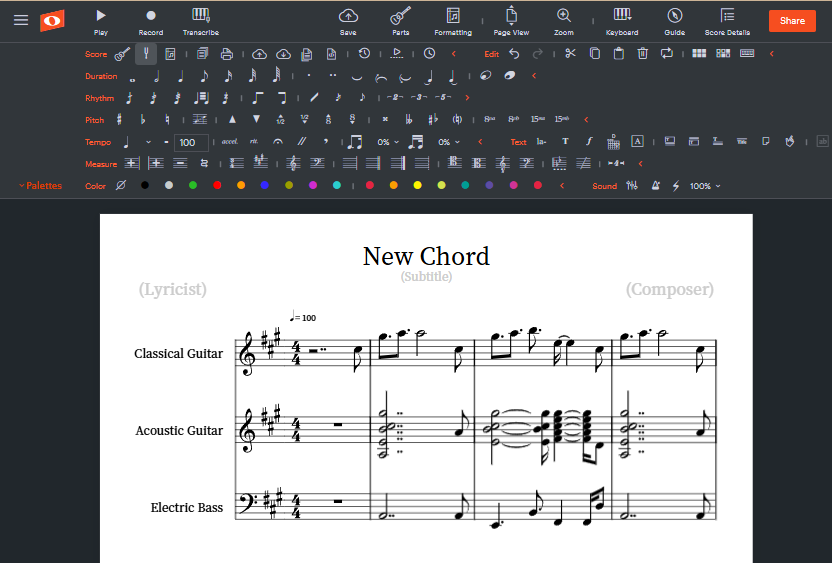
Noteflight has an easy and mostly intuitive user interface that allows a composer to bring in almost any instrument. The patch quality is ok, which is why I use other software to complete my tracks, and there’s a limited set of patches available. In addition, the guitar tab feature could be improved. But overall, it’s completely usable and works well for the ideation phase.
I typically will get a track about 85-90% done in Noteflight. I try to get the entire album into this “almost there” state, because after this I have to commit to working on desktop applications which can limit my access.
Finalizing Drafts
I finalize my drafts in a desktop application called Notion, by Presonus. I do this for several reasons.
First, the guitar tab feature is highly integrated; moving either the note or the tab position adjusts the other, a seamless experience that allows me to go back later and plan how I will play the parts in a way that makes sense in terms of the guitar neck. It also allows me to check my chords to see if they are actually physically reproducible on the guitar. I can set the tuning of the guitar within the software to match what I will play, so I don’t have to transpose the parts when I go to actually play them, if I’m detuned a half step or in an alternative tuning.

Secondly, while the Noteflight patches are good, Notion’s are higher quality and have more choice. This allows me to start to hear the track as it is actually intended to make sure I am not missing something.
Although rare, I do occasionally use MIDI to bring in parts from my keyboard, and Notion has all the expected built in MIDI features that allow that to occur. Notion also provides better contextual feedback, such as timestamps within measures, that make planning the ultimate outcome of the track a little easier.
The one complication here is that the actual note input itself is cleaner in Noteflight than in Notion, and at times I do have to come back and write or make major changes to tracks at this stage, which takes a little more time.
Moving to Recording
Once the track is “completed”, I export it to a MIDI file that my DAW will understand and move to recording of live instruments.
Be welcome and true.

 Rob Hope