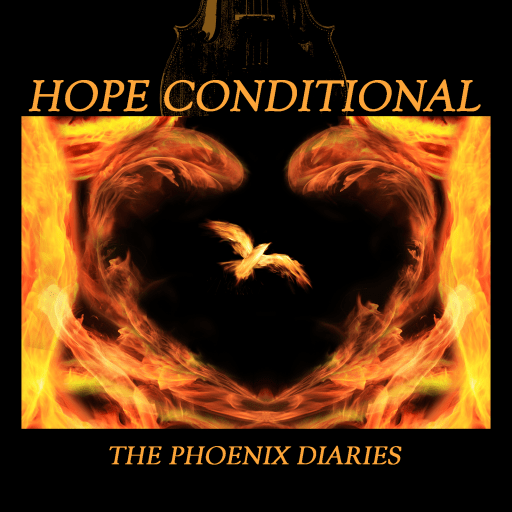
About The Phoenix Diaries
Released: April 2022
Introduction
I’ve realized something over time with my composing, and that is, sometimes I don’t trust my own ideas, and need to get some sort of clarity or inspiration elsewhere. That was never more true than this album. This was the hardest to write when compared to my goal, which was another cohesive story-telling soundtrack. I eventually landed on the idea of the outlining the life cycle of a phoenix. Certainly not the most original, but it gave me a starting point, gave me a structure, and combined with a few technical themes, allowed me to complete this release.
Available on Spotify, Apple Music, YouTube, and Amazon Music.
Themes Explored
This is another story as soundtrack symphonic rock album. I bring in an entire orchestral arrangement again, which to a degree felt more limiting here than on the Zombie Chronicles because I had no specific characters or concepts to represent, at least not with the same depth. This was freeing but also limiting in a way, as I could pick random song titles to focus my idea, but some of my titles ended up being repetitive.
During this time I also purchased a 12-string guitar which I used on many of the pieces, including Dawn, which I wrote after bringing the instrument home. I began including 12-string on many of my songs on this and subsequent albums. I had also purchased a Jackson 6-string to give me a slightly different tone than my Fender Stratocaster, and detuned it one half step to give me more options for my rock themed instrumentals. These changes expanded my tonal vocabulary.
Specific Techniques Explored
I engaged with a couple of new techniques such as reharmonization. In several songs I reharmonized the original idea to give depth and nuance. Reharmonization is the musical process of changing the chords under an existing melody to create a different mood, style, or level of complexity, providing an alternative harmonic context without altering the melody. In one case, I felt that the effort significantly raised the song quality.
I also picked some specific chord structures to engage for this album. As a fan of George Lynch, I’ve often utilized the flatted fifth in power chords for texture. For this album, I focused on using the flatted fifth in a more complete chordal setting, extensively using both maj7b5 and min7b5 chords across many of the tracks. Heaven Calling, in particular, uses maj7b5 chords as the basis for the entire verse’s melody. Many of my reharmonization efforts found natural spots for this particular strategy.
I also continued my extensive use of unexpected yet naturally implemented key changes, alternative time signatures, and revisited my use of polyrhythmic time, with one song combining 13/8 with a 4/4 polyrhythm. One song also shifts its time signature from 9/8 to 4/4 while maintaining the same general melody and chord progression, providing a different flavor without a change in tonality.
Guitar wise, I introduced double stops into my solos as a specific choice. I don’t do them very well and was concerned they wouldn’t translate to record, but they ended up working out. Percussion wise I changed feel much more often this release, experimenting with a lot more half and double time changes.
Songs
Love Will Rise
Key(s): A Lydian, C#m, B Lydian Time Signature(s): 6/8, 4/4
Given the choice of narrative context, I open with a short orchestral intro that seeks to remind the listener of sorcery. I have always love the tonality of the oboe, and recently discovered the English horn in my list of samples. Combined with a violin, these three instruments open our story, and then the oboe leads the transition to the opening guitar riff, a sweeping motif that is used throughout the album, arpeggiating up the C#m chord and then down through a B, as the bass shifts context from C# to A to F# and back up again. This up and down motion is key to the motif wherever it is used throughout.
The track ends with a shimmering outro in B Lydian, using a number of add9 chords and a lengthy guitar solo. The outro also features another technique I use often, moving single notes of chords as the progression changes, going from a B9 to B (the C# to the D#) to a Bmajb5 (the D# to an E#) to a C# major chord to close the phrase.
The Cycle Begins
Key(s): Eb Phrygian Time Signature(s): 4/4
The first of several tracks requiring a half step down tuning, bringing a lot of my metal influences into play. The intention is to set a mood of power and energy, perhaps the slight fear one might have encountering such a powerful animal. The verses feature typical progressions built around a motif including a flatted fifth chord, and the prechorus brings in a strong, droning bass driven rising progression that builds to the chorus. The oboe returns to the melody during the chorus to give it a haunting focal point for the guitars to swirl around.
Dawn
Key(s): Em Time Signature(s): 4/4
This was the easiest song to write, and I think it shows in the song’s quality. Two things happened prior to the writing of Dawn. My cousin, for whom the song is named, passed away after a long illness. Around that time, while returning a rental clarinet at the local music store, I happened to glance up at a gorgeous 12-string guitar. Before I could resist, I asked to try it out, and that’s how musical instruments end up coming home with me.
My cousin was very into art and entertainment and music like myself, and once I had the 12-string home, I thought of her and wondered what I could write in her memory. This song is what appeared.
Musically, I wanted to work on my counterpoint harmonies, and the oboe and bassoon here strike the perfect mood. Inverted chords help set a tone that’s somewhat bright but without feeling resolved, and the string motif at the end of each verse progression conveys hope and motion.
This remains one of my favorite tracks.
The Chosen
Key(s): F#m, G#m Time Signature(s): 4/4
One of the things I wanted to try in my music was the use of percussion as melody instruments. Thus was born this track, which uses xylophone and vibraphone as the main melodic owners during the verses. The result is a tribal feel to the main sections of the piece, with the tempo and bass driving the song forward.
How Shall I Save Your Soul
Key(s): Fm Time Signature(s): 4/4
This song took years to bring to life. I had the basic chord progression written well before I started the album, but could never find the correct melody in my mind. I knew what I wanted it to feel like, but could never get to something that really satisfied me until late in the writing of the album. Steve Vai’s For The Love Of God and George Lynch’s I Will Remember were inspirations for this piece from a tonal perspective. Eventually I came up with the first few notes, a rising lick that lands on the minor 7th before slowly tumbling down. From there, the song opened up to me, informing the various orchestral ornamentation and harmonies floating behind the main guitar solo. I consciously introduced double stops during this song, and changed drum feel to double time for the middle section. One of my personal favorite moments is the end of the phrase at 3:53, it’s one of the few times I feel my playing had feel rather than seeming mostly mechanical. One of my stronger efforts as far as being able to produce the feeling and result that I originally intended.
Halo Of Scarlet Gold
Key(s): A Dorian Time Signature(s): 9/8, 4/4
This song is one of the more unique writing experiences. While the song is in 9/8, the syncopated drum patterns change each section, giving the song more variation that might otherwise be expected. During the first section, the hit on the 2 and 4 if you count the 9/8 as a bar of 4/4 with an added 1/8. The second section shifts those beats forward an eight note, so that they are now on the and of 1 and the and of 3, before returning to the first section. During the bridge, the pattern changes to a straight 3/4 waltz beat. At the close of the bridge, we return to the first section’s melody and progression, but this time it’s condensed into 4/4, essentially removing one beat from the progression. Familiarity remains, but things are slightly changed, with a more stable and faster pace to the music.
A Healing Tear
Key(s): Gm Time Signature(s): 4/4
Featuring a call and response verse between cello and oboe before shifting to a forlorn viola bridge, this song evokes the need to heal from wounds both physical and mental. The energy is soft, the melody slow, and the shift in tonality feels effective. Towards the end of the song, the percussion moves to double time to provide a sense of hope.
Freedom To Fly
Key(s): Cm Time Signature(s): 4/4
The joy of freedom in flight. This track calls back to the original riff from Love Will Rise both in its chosen chords during the chorus as well as explicitly using the same sweeping chord technique during the middle solo. It also brings in a maj7b5 chord at the end of the chorus phrase as well. Using both of these as call backs and the foundation helped bring the song to life. I was initially skeptical of this track as I wrote it, but now the uptempo arrangement and lively instrumentation feels infectious to me.
Touch The Sun
Key(s): Fm, Abm Time Signature(s): 4/4
An homage to some of my favorite rockers including Led Zeppelin. To a degree, I wanted to evoke the flight of Icarus here, as a bird of fire might seek the sun. The point of failure is represented by the slower paced middle section over clean guitars, with a key change up a minor third; the progression is one of the more unique ones I’ve written, moving from Abmadd2 to an Ebm/Gb to Fbmin7b5 to Absus2/F, all over an Ab drone in the bass, with the bass changing to follow on second passes through the progression. It’s not clear if the emotional effect was achieved with this song, but I like it as a progressive rock track.
Darkness Shatters
Key(s): A Phrygian, G# Phrygian, Cm, Am, Bm, E Dorian Time Signature(s): 4/4, 7/4
A mixture of mystery and energy surrounds the creature, and as it ignites, the darkness shatters. The opening chord progression for this track is also one my more unique arrangements, moving from Dm/A to Bb7b5 to Gm#6 (or Gdim7(no 5)) to a walk through Dm/F – Em7(no 5) – Em7 (no 5)/G – Bb before returning to Dm/A. Removing the 5ths from the chords enables this to stay melodic despite the Phrygian and Locrian tonalities that are implied, granting darkness without dissonance. The use of a semi-tone down key change and the introduction of some heavy guitar delay increases the sense of mystery the second time through the progression, while the flute and viola sing their song.
The song cycles through various different chaotic sections, including a lengthy section in 7/4, before closing with a sense of hope now that the darkness is gone.
On Scarlet Wings
Key(s): Am, E Phrygian Time Signature(s): 4/4
I wanted to open a song with an energetic guitar run to convey excitement, and this is the result. This is a mostly straightforward rock song, with one notable exception. There is a middle section in E Phrygian at 2:25 that features horns and a decidedly Latin feel to the ornamentation, with Latin percussion and a syncopated melody. The guitar joins the horns during the second part of the middle section but doesn’t compromise the overall melodic integrity. It was a surprise when it came to me but definitely one of the more inspired choices on this release in my opinion.
Am I Beautiful
Key(s): D Dorian, Bb Lydian Time Signature(s): 4/4
This song is based on an old progression of mine, one that I think is one of my prettiest. I brought it in to represent the beauty of the phoenix. The chords shift between major and minor tonalities, both by selectively including the minor 3rd during the verses, as well as adjusting the 6th (both B and Bb are used where appropriate), with the chorus committing to Bb Lydian before returning to D for the verse. Oddly enough, finding the correct overall tone for this piece was tough until I finally placed the melody on the piano; that solidified the overall feel of the piece and allowed me to complete it in a way that felt natural.
Heaven Calling
Key(s): A Mixolydian, Eb Dorian, C Mixolydian Time Signature(s): 4/4
Death (and rebirth) is soon approaching for our phoenix. Given that dichotomy, this song is firmly rooted in Maj7b5 chords that resolve to the maj7 chord. The verses alternate between Amaj7b5->Amaj7 and Dmaj7b5->Dmaj7, with melody dancing around the tones that lead to those resolutions.
There is also a moment at 3:55 inspired by something I once saw in an analysis of Celine Dion. The bridge section ends with an E natural over an Abmaj7b13, with E being the b13 of the chord. The note holds while the rest of the instruments drop out, and when the music returns, the note still holds, but we have transitioned up to C from the original A, with the E natural now the 3rd of the Cmaj7b5 that introduces our return to the main motif. This use of a single tone across a key change, changing the meaning of the note with changing the note itself, caught my attention and is something I’ve occasionally used with impact. The analysis referred to this as the “god note”, and given the title of the song, it felt appropriate to try it out.
Shadows
Key(s): Ab Mixolydian, Gb Lydian, Cm Time Signature(s): 7/4, 4/4
Despair before rebirth. This song is mostly in 7/4 giving it an uneven pace, and the chord progression features ringing notes a semi-tone apart, with first a chord of Cb – Gb – F / Ab, followed by Gb – Db / C / Db, on the acoustic guitar. This eerie voicing sets the stage for a track focused on uncertainty and shadow, more mood than melody. Primary voices are given to the bassoon, oboe, French horn, and cello, providing even more darkness.
The Calm Before
Key(s): G Mixolydian, A Mixolydian Time Signature(s): 4/4
I’d had this chord progression in mind for a long time, but could never quite fit something to it that made it anything more than a standard VI-V-I chord progression. Then I chose to reharmonize parts of the song, and clarity arrived. The original progression is intact in the final instance, taking the upbeat, major feel to the progression to end the song in happiness.
The original progression: C9 – D9 – G – G/B, C9 – D9 – G – Em, C9 – D9 – G – G/B, F – F – C – G
Switching to minor or alternate versions of several chords put a lot more nuance into the verses which made the section more interesting, while enhancing the power of the original progression when it returns at the end up a full tone key change.
The reharmonized progression: Am – D9 – G – G/B, Fmaj7 – Fmaj7b5 – G – Em, C9 – D9 – G – G/B, F – Fmaj7b5 – C – G
There is a second part of the song at 1:33 that I also am proud of. During the section section of the verse there is a flowing melody over a quarter note piano motif. That motif I heard in my head and it ended up sounded exactly as I had imagined it, which can be difficult for me.
Incineration
Key(s): C#m, Em Time Signature(s): 13/8 with 4/4 polyrhythm, 4/4
As I’ve mentioned, I try very hard to conceal my complexity within the music I craft, and this is no exception. The intro and verses of Incineration are in 13/8, and by the time you get the sense that the rhythm might be off at the start of the piece, it returns to 4/4 for the chorus. Verses after the first chorus feature a 4/4 polyrhythm drum pattern under the 13/8, sometimes in half time, later in double time, adding to the vague sense of unease. A bass line shifting up and down a semi tone adds to the strangeness, but unless you try to count the chord changes, it’s never quite clear what is off. Adding in key changes first up a minor third, then back down a minor third, add interest and intrigue to an otherwise standard rock instrumental.
From The Ashes
Key(s): Ebm, Em, E Time Signature(s): 4/4
Rebirth. The track opens with another Fmaj7b5 chord that shifts down Em to resolve the tension. The shifting bass line echoes Incineration during the introduction as strings flow above the growl. As the rise begins, guitars join as the sweeping arpeggio progression from Love Will Rise backs the track. Following a brief chordal interlude, strings sound the rise of the phoenix, until the track segues into a triumphant ending, changing from Em to E major, announcing the bird’s return. One of the interesting things about the ending is that the primary phrase is only 3 bars long, not the typical 4 bars long, giving a sense of urgency and freshness.
Peace Remains
Key(s): E Time Signature(s): 4/4
The end of the cycle. The song uses similar picking patterns on the acoustic guitar to Am I Beautiful, answering that question with a “yes”. The progression has borrowed chords throughout, including C and D major chords to return to the E, and some minor passing tones, such as an open G during the transition from B major back to E major at the end of the verse. Choral voices add to the sense of wonder and peace as the album draws to a close.
Conclusion
This album has grown on me. I think song to song it’s stronger than the Zombie Chronicles, but is much weaker from a story telling standpoint. That said, it features some very successful attempts at complexity, in particular tracks like Incineration and The Calm Before. While the inconsistency still troubles me, overall I’m happy with the result.
Be welcome and true.

 Rob Hope