About Servings of Sadness
Released: December 2025
Introduction
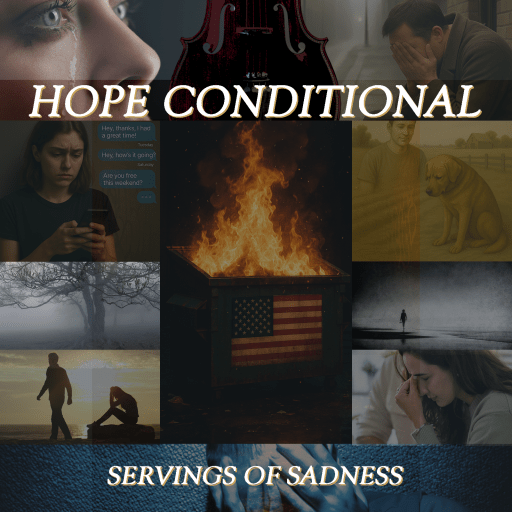
While I considered what next to do from a classical music standpoint, and after a couple of failed attempts to start a symphony, I considered the possibility of stripping down to basics and writing an album solely of rock songs and another solely of ballads, and simplifying to a smaller set of music. Ultimately, that idea failed me; and I ended up with Servings Of Sadness. Named after an iconic quote from a colleague of mine, “That’s two servings of sadness!”, I decided to strip down to basics, yes, but settled on trying to articulate some of the feelings that have been percolating under the surface over the last year. The country is not doing well, society is not doing well, and professionally as I was writing this I was also going through challenges. That all tumbled out into this collection of music, another 18 songs.
Available on Spotify, Apple Music, YouTube, and Amazon Music.
Themes Explored
I changed how I approached this album thematically, naming them after I wrote them rather than working backwards from a title or an idea. There are a couple of exceptions; The Seventh Starship grew out from the title and the opening augmented chord sequence, and Election Day was inspired by the political environment of 2025. As I stripped down the instrumentation, I focused a lot more on writing melody for piano, a challenge as I don’t really play the piano. That made the writing of this more involved and more difficult, as reproducing what I hear in my head on a keyboard would require me to have context on how the piano might sound in the first place. I’ve listened a lot of YouTube piano content over the years, though, and applied a lot to this, and overall I’m happy with the results, especially on As Your Rose Fades Away and Extended Melancholia.
Specific Techniques Explored
The only technical focus I brought in to this album, on top of my already liberal use of key changes and alternative time signatures, is a heavy focus on extended chords. There are several songs where there are two acoustic guitar tracks, one outlining the main part of the a chord, the other one outlining the 7th, 9th, 11th, or 13th notes as appropriate. My interest in expanded my piano composition also led to more use of these chords. I also focused on heavier obfuscation of key changes, in particular mixing changes down with tonal shifts upwards to make them seem less dark or jarring. I made some changes to how I approached the overall percussion as well after stripping away orchestral drums, focusing on accents on the hi hats and more creative linear-style fills.
That said, there are more songs here that are more consistent rhythmically or key wise, but rely on extended voicings instead, which I feel ultimately led to a more stable set of songs with less obvious experimentation, which means there is less to talk about as far as technique here, and that’s ok.
Songs
Misremembrance
Key(s): F Lydian, Am, Bb Lydian, Gm Time Signature(s): 4/4
The opening song to the album, featuring a slow build in F until the main acoustic guitar enters in Am. I was ruminating on short-term memory loss as I was writing this, at least I think I was, and that’s where the title comes from. The interesting technical things here are the use of the borrowed E major chord in the verse, and the shift to Bb Lydian in the second half of the verse, with its flowing melody and syncopated drum patterns in the second half of verse, which liven the otherwise somber tone. The key drops to Gm for the middle section, before returning to the opening acoustic motif while staying down a full tone key wise.
Enter The Dreamer
Key(s): E Dorian, F Phrygian, G Phrygian Time Signature(s): 4/4
My first foray into heavy use of extended chords, while bringing back my love for the flatted fifth, which is featured in the chord progression for the opening section. Few if any of the chords in this piece are standard, with many of them adding 9ths, 11ths, and 13ths, in both major and minor. Since I’ve removed nearly all of the orchestral instrumentation, I placed the melody in the organ and piano for the most part, expanding my sense of harmony. There’s a lot of sweeping melody in this song, and I very much tried to hide the foundational complexity within the dream-like note choices.
Holding On To You
Key(s): C, C#, E Lydian, B Mixolydian, C Mixolydian, Dm, C# Mixolydian, D Mixolydian, Eb Mixolydian, E Mixolydian Time Signature(s): 6/8
This song features a key change at every transition, as the verses and choruses both step up a semi-tone before the next; I believe I succeeded though in obfuscating the change away until the ending third of the track. Oddly enough, the score of this I had to leave in C and just decorate all the notes because of how often the key and tonality shifted. This song more closely resembles my previous albums, with the melody in harmonized guitar and a more energetic percussion arrangement.
Solitary Confinement
Key(s): G#m, Am, C, Abm, Bb Time Signature(s): 4/4
In this song I focused on atmosphere more than any specific technical aspect, as I did with many of the tracks here. While others may disagree, I found solitude or being alone to be a comforting thing more often than not, especially in my childhood, and the uplifting changes as the main section comes to resolution reflects that, along with the generally positive tone of the track’s conclusion. I experimented with both major and minor 6th chords here, setting the stage for later songs that are built on them from the beginning.
Wanderlost
Key(s): C, B, A, Am Time Signature(s): 4/4
Another track focused on atmosphere over technique, but I am very fond of this one, in particular some of the melody choices once the guitars come in and take over the melody after an energetic middle section featuring a call and response between the solo guitars. There are some interesting chord choices in the main section, including a shift from an F major to an F minor 6th, and the introduction of Amin/F# to Dm, and a Bb9 shift to F/Bb. The key changes from C to B, down a semi-tone, when the main section switches to the more chorus-like section, but it lacks the usual darkening tone as the melodies are shifted up, making it feel more like the key change was in a positive direction.
Extended Melancholia
Key(s): Eb Time Signature(s): 4/4
One of the few songs that stays home both key wise and time signature wise. I came up with the melody to this humming to myself while cooking dinner, which generally is a sign of melodic strength, when I can sing the melody to myself in some fashion. That’s where the simplicity generally ends though; this song was inspired tonally by a video on 6th chords, and I absolutely tried to make every chord I could a 6th. The opening piano motif uses 6th chords everywhere, and where it can’t, it uses 11ths or 13ths, both major and minor. I focused the acoustic guitar on the standard parts of each chord, and gave the extended notes to the organ to give it a dream-like quality as it rises above the foundational guitar and the melody of the piano. There is an extended coda that slightly shifts the melody and progression as well after the song seems like it should have ended. All of which contributes to the “extension” of the melancholy feeling I was looking for and believe I successfully captured with this piece.
Ghosted On Fourth Street
Key(s): Am, B, Bbm Time Signature(s): 4/4
The concept of ghosting has become an internet phenomenon of late, and I wanted to see if I could represent the confusion, followed by the sense of loss, followed by the sense of anger that ghosting might cause. This might be my least favorite track on the album; I feel I forced a couple of things as far as harmonic experimentation, including the chromatic chord shifts in the introduction as well as some borrowed chord choices in the opening section, where the chord progression goes from Am to C#m/G# to G to D, with the 2nd and 4th chords both outside the key. There are other interesting tonal choices as well but overall the track lacks harmonic cohesion.
Amber
Key(s): Db, Eb Dorian, Bb Time Signature(s): 4/4
This was another enjoyable track to write. It started with the main acoustic motif with the little jump at the midpoint, and blossomed from there. The progression for the main motif is interesting, primarily using min7add6 chords or min7add9 chords throughout, keeping with the theme of using extended chords. The final time through the progression as the track closes is punctuated by a higher energy percussion track and a freely moving bass line that I wrote very late in the process when I felt like the conclusion of the track needed a little something more.
Once Was Enough
Key(s): Fm, Gm, G#m, C# Dorian, D Dorian Time Signature(s): 4/4
This track appeared one day I was noodling on guitar, and eventually made its way to a complete idea. This is another melody that came to as I was singing along with the progression, and the lively bass line adds to the energy. While this track lacks some of the more sophisticated chord voicings I was experimenting with, I enjoyed its simplicity and the ease with which it came together.
Was That Not The Case
Key(s): F#m, F Lydian, G#m Time Signature(s): 15/8 with 4/4 polyrhythm, 4/4
Leveraging add9 chords and incorporating the borrowed major 4 chord, this guitar infused track is intending to evoke confusion in the face of misdirection. The lengthening of the chord structure due to the odd time signature, along with a 4/4 polyrhythm, gives the track a unique sound that was enjoyable to craft. The use of the organ as the voice of the extended parts of the chords continues here, especially in the slower middle section that brings in familiar min7b5 voicings among others, where the b5 is held across the entire of the chord set, changing meaning from b5 to minor 3rd, to add9 as the tonality shifts.
In My Own Space
Key(s): D, G Lydian, E Phrygian Time Signature(s): 4/4
There are several songs where the melody was written on guitar, but the song didn’t feel complete until it was moved to piano. Such is the case here, with this track, which is also enhanced by a doubled organ on the melody. Shifts in drum pattern impact and accentuate the mood of the piece, and several runs feature quintuplet groupings of notes. Use of the minor 4 chord adds a somber tone to the brighter major tonality of the song.
The Seventh Starship
Key(s): C#m, Ebm, F#m, G#m Time Signature(s): 7/4, 7/8, 5/8, 6/8, 11/8 all with 4/4 polyrhythms
I had this idea of a starship lost in space. I also had this idea of throwing everything “spacey” I could at the concept. This is what emerged. Shifting in and out of polyrhythm across a track that never settles into a predictable beat, nonetheless there’s a forward energy to the song. It opens and closes with an A augmented chord, the signature “space” chord. From there it cycles through keys and melodies and odd meters, even settling into a middle section in 11/8 at 3:45. 11/8 has become a favorite time signature of mine. It’s always a challenge to come up with melodies or ideas that seem fluid in spite of what’s going on rhythmically underneath, and I feel like this works pretty well.
Introversive Isolation
Key(s): A, B Time Signature(s): 4/4
A pensive yet bright piece. The exotic tendencies of most of the album are set aside here in favor of a simple, memorable melody. The piano melody that starts the track and continues throughout was the starting point for this song
Why
Key(s): Dm, Em Time Signature(s): 4/4
The electric piano motif was the start of this moody track that eventually became fairly interesting as I worked through the arrangement, including specific differences in the percussion and its syncopation. The straightforward chord structure layers 9ths and 7ths within the organ, a common theme on the album. The counterpoint of the guitar melodies make this track work, with some interesting phrasing at the end of each melodic line.
Meadowlarks
Key(s): A Mixolydian Time Signature(s): 4/4
There’s almost a skip in slow motion feel to this song, which is powered by a bass dominant 7 on the 3 of each bar followed by the root immediately on the 4. This creates a loping feel that drops out when the section moves to a more energetic second part. The chord progression adds to the whimsical feel, shifting specific notes between each chord, Bm9/A to Bm/A to A9 to A, creating a slight tumble to the chord voicings. Syncopated percussion patterns add to the chorus of the piece and keep it moving in spite of the slower tempo.
This Broken Soul
Key(s): Cm, C Phrygian, D Locrian, G Phrygian Time Signature(s): 12/8
Although the time signature doesn’t change, there is a definite different feel to the introduction of this track as opposed to the primary sections with the dotted eight note chord voicings and the half time percussion feel, which is odd because the introduction is what came first; once the track was written it only appears twice in the song, as the rest of the track takes on its own personality. There are some interesting chord substitutions in the middle section of each verse / chorus combination (Dm – Cm – Bb Fm with the occasional F major substituted, echoing the opening Dm chord), and an overall sense of liveliness to the track driven by the piano voicings and bass.
Election Day
Key(s): Em, C#m, G# Locrian, Abm, B Phrygian Time Signature(s): 4/4
This song started as a thought experiment: could I open the song by confusing the listener where the overall rhythm was? The song appears to open on the 1 of its opening bar, but in reality the first note is on the “and” of 4 before going into the first measure. This isn’t clear until the drums kick in fully, causing the first hi hats to seem out of beat. Other notable songs have done this, and I thought to give it a try given the acoustic intro in this song.
This song also become the target for much of my dissatisfaction with recent history. It is intended to be angry, disillusioned, and determined. The more sinister undertones both in key and rhythm choice are very purposeful here.
As Your Rose Fades Away
Key(s): C Mixolydian, C# Mixolydian Time Signature(s): 4/4
The closing song of the album, and the strongest. Shifting between Major and Mixolydian mode, and tastefully adding extended chords here and there, I consider this one of my best compositions harmonically. The themes of melancholy and forlornness resonate here, and the choir voices add to the ambiance. The melody is simple yet interesting, and the verse closes with a turnaround featuring several borrowed chords, shifting from Em7 – A – Eb – Dm – G before returning to the root chord of C. This turned into much more than I thought it would when I started with a simple piano trill, now featured in the third set of notes in the chorus.
Conclusion
I pulled back on some of my “principles” on this album, sacrificing narrative continuity and concentrating more on atmosphere and musical growth while trying to express some of the negativity of the last year. There are some excellent highs on this album for sure, and some of my prettiest piano compositions. In retrospect, I might have stuck with my original idea of two smaller albums, one for the contemplative work, one for the hard rock work. Overall though I like listening to this record and the different flavor it has from previous works.
Be welcome and true.

 Rob Hope