About Numericoncerto
Released: March 2024
Introduction
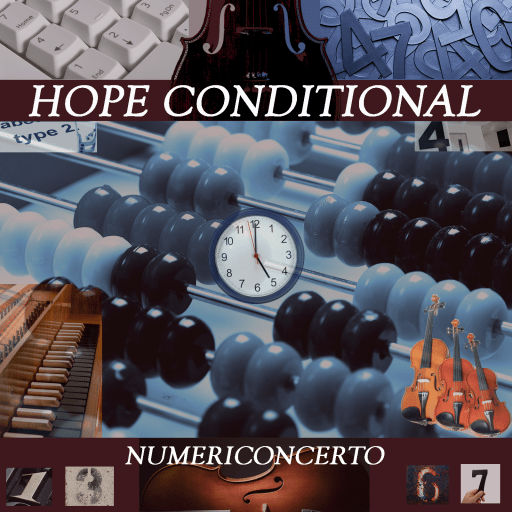
After four albums of mostly guitar-driven symphonic rock music, I wanted to coalesce all the goodness I had learned from my online research and see what I could do if I stripped myself down to a very basic orchestral setting. I challenged myself to work with only 7 instruments: a six-piece string section and a harpsichord, and to write a cohesive, classical work.
This is the result. While it was difficult at times to write, it was easier to produce; once the composition was completed, I did not have the long hours of recording guitars to contend with and could move right to mixing and mastering.
Available on Spotify, YouTube, and Amazon Music.
Interestingly, Apple Music doesn’t accept what appears to be classical music for whatever reason.
Themes Explored
Rather than focus on narrative themes, I chose this time to focus on how the classical structures, including tempo and mood, influenced the musical outcome. It was easier and harder at the same time to tell myself that the second piece of a quartet should be faster, the third should be slower, rather than try to make something up on my own thematically.
I did try to connect thematically across pieces though; the last two pieces of my sextet were intended to feel as if they slowly gained power to an epic conclusion, with the last piece attempting to echo themes one might find in Marvel or Star Trek. The third of my vignettes serves as a coda for my quintet while still feeling independent.
Specific Techniques Explored
Due to instrument choice, I had to really buckle down on timbre and tonal selection, and worked hard on moving parts of the melody from instrument to instrument for impact. I had to be deliberate in my choice of harmonies on the harpsichord given its lack of a ringing tone. I definitely felt the absence of background chord arrangements and had to think more discreetly about where notes would land within the arrangement. In several places, I had to be patient and let the track build. In others, I had to be ruthless and cut out parts that were too repetitive.
I also continued exploring more varied time signatures (17/8?) and I composed a piece in quartal harmony as opposed to the typical tertian harmonies found in music today, which was an enlightening and interesting challenge. I expanded my use of modes and tempo nuance, and continued my use of key changes in subtle ways. I also continued to explore re-harmonization as a way to achieve variety of tonality.
I constructed pieces using counterpoint, and investigated Baroque techniques for chord progressions. I followed traditional sonata and quintet structures. I came up with the idea of “Vignettes”, or bridge pieces, that were shorter than I usually compose, to see what I could communicate in two minutes rather than five or seven. Two of those vignettes I’m fairly proud of, given they have so little space to communicate.
Songs
The Arclight Sonata
A sonata is a piece that consists of 3 or 4 movements that can be for different musical instruments, including:
- Allegro, or up-tempo, development of the theme in the first movement.
- A middle movement, most frequently a slow movement.
- A closing movement as an Allegro or a Presto.
The Arclight Sonata blends influences from the Muppets, The Warning, and 80s rock melody and was my initial attempt at a classical structure. It utilizes two main themes, with the second them in the 1st movement opening the 3rd movement to tie the two together. The harpsichord is not involved at this time; this is a sonata for strings.
The Arclight Sonata, 1st Movement
Key(s): Bm, D, G Lydian, E, F# Dorian Time Signature(s): 3/4, 4/4
The 1st movement introduces two themes. That are used throughout the sonata. In addition, there is a short opening motif that is also used to close the sonata at the end of the 3rd movement and is used throughout the sonata as well.
The first theme, in Bm to open with somberness, is in 3/4. Partway through the opening theme, it is shifted up a minor third, and the chord progression reharmonizes to the relative major key of D, giving the theme a brighter feel; at the conclusion of that, the melody is given to the violas and reharmonized again to G Lydian. From there, the instrumentation mostly drops out, returning the melody to the violins in the spirit of contemplation, ending with a variation of the opening motif, before transitioning into the next theme at 3:45.
The second theme transitions to the key of E and 4/4 time. It slightly echoes the opening motif, but has a more upbeat feel and a brighter tonality, until it steps up to F# Dorian and introduces counterpoint between the violins.
The movement closes by returning to the second theme in the original key of E major.
The Arclight Sonata, 2nd Movement
Key(s): D Mixolydian, E Major, E Mixolydian Time Signature(s): 3/4
The 2nd movement extends the second theme from the 1st, slightly lengthening it as the time signature shifts to 3/4. The choice of mode gives it brightness and an invitation to dance before shifting to a section featuring a line cliche based progression that includes a m7b5 chord as part of its tapestry, before returning to the more danceable main theme. After that, we shift to E Major and double down on the energy with a lively string them, before coming back to E Mixolydian (a full step up from the original key), and gradually reintroducing the main theme to wrap up the piece, with each instrument coming in to add their own flair to the melody.
The Arclight Sonata, 3rd Movement
Key(s): B, Bm, D Time Signature(s): 4/4
The closing piece, which both opens and ends with echoes of earlier themes from the 1st movement, including closing with a reprise of the opening theme. This piece stays mostly lively, with major tonalities, in keeping with the structure of a sonata, with the exception of a middle section that transitions from the major to the minor key.
Overall, while I like The Arclight Sonata, I think I had to think too much to complete it, and was overly focused on technical execution.
The First Vignette
Key(s): D, C# Phrygian, A Dorian, F# Phrygian Time Signature(s): 4/4
This is the first bridge piece, or vignette, a short piece that transitions from the sonata to the quartet. It has only 3 string parts, requiring a focus on simplicity. There are several unique moments; the introductory progression features a major minor 3 chord and a major minor 1 chord in the D major key before immediately changing to Phrygian mode (Fsus2, to Ebsus4, to C#m in A major), and repeats it at the end when the key has shifted to F# Phrygian (D major). The violin opens the piece melodically with a sober, yearning phrase, and the viola steps in to heighten the darkness during the middle third of the piece. The second violin section places the original melody a full fifth down from the opening version, adding to the overall sad tone.
I was very happy with how this turned out, given the track is two and a half minutes long. It is an instance where I felt like I accomplished all I wanted to when I started writing this track.
The Counter Quartet
The Counter Quartet also focuses much more on technical execution and learning that it does on musicality, but in this case, I believe my choice of melodies and themes are a dramatic improvement over the sonata. In particular in the 1st and 4th movements, I stay away from some of my more exotic tendencies as far as changing keys and tonality, allowing the music to sit comfortably in its space. The 1st movement definitely focuses on counterpoint technique; the rest of the movements work off of that idea but are not quite as locked in on the technique itself.
The Counter Quartet, 1st Movement
Key(s): C Time Signature(s): 4/4
Counterpoint in classical music is the technique of combining two or more independent melodic lines (voices) that sound simultaneously while remaining rhythmically and melodically distinct. In this piece, I get to third counterpoint, where on each successive pass through the melody, I subdivide the notes on the next included instrument. The piece opens with a melody on the viola, then two subsequent violins come in, the first dividing the original notes in half, the second dividing the original notes by four. As my focus was on melodic complexity, I kept the track in a consistent key and time signature, with a couple of exceptions including the occasional shift from the major 4 to the minor 4 chord to add depth.
In spite of the thought necessary, I really like how this turned out from both a tonal and melodic standpoint. I will continue to look for more ways to use counterpoint in the future as a result.
The Counter Quartet, 2nd Movement
Key(s): G Locrian, F Locrian Time Signature(s): 4/4
In this track, the counterpoint is tonal to the 1st movement. I return to my love of the challenge of writing in Locrian mode without it seeming too evil or dissonant. The focus here is sharp tones, with a lot of movement in the lower registers, with a slower, melodic theme that foreshadows the themes in the 4th movement. The track raises the energy with a march using short notes to counteract the lack of percussion in the arrangement, but lowers the key by one step to increase the sense of doom, before returning to a reprise of the opening section.
The Counter Quartet, 3rd Movement
Key(s): Fm, Abm, Gm Time Signature(s): 4/4
Following the same general structure of an opening, a middle, and a closing section as the rest of the quartet, this somber ballad traverses several minor keys with a funereal feel. There are several excellent moments in this track, in particular when it returns to its main theme after the middle section, up a full step in key from the original, but down a half step from the middle. This change provides a duality in the contrast, power, and energy it brings the otherwise mourning melody.
The Counter Quartet, 4th Movement
Key(s): Ab Time Signature(s): 4/4
In this piece I attempted to start with a catchy rhythmic motif that would be recognizable and carry the track. The motif follows the melody throughout as a form of punctuation. There are bits and pieces of actual counterpoint technique throughout as well, and in many places I look to balance short, staccato notes with lengthier melodies for contrast. In general, I think this is a good closing piece for my quartet.
Overall, I think I was able to take an initial technical idea, counterpoint, and use it as a springboard for an enjoyable quartet.
The Second Vignette
Key(s): C, A, Ab Time Signature(s): 4/4
The second vignette I wanted to see how I could combine melody and speed within a short time frame, basically applying how I might think about guitar to a singular concept. All three melodic string instruments have difficult triplet runs to execute, as does the occasional cello part. The tonality is mostly major, and the keys do change, once down a minor third, and once down a semi-tone. The key changes provide contrast, in particular the switch from C major to A major, which uses a D major and E major chord as an approach to A, generates a brighter tone as the melody changes to eighth notes, and the semi-tone drop for the third section actually feels more warm than might be implied. In spite of the speed, I felt that the overall melody maintained integrity in a satisfying way.
The Basic Harmony Quintet
I think the quintet is my strongest set of music in this concerto. It is structured in five movements rather than the original four, and I bring in a harpsichord instead of a piano. I am particularly fond of the 1st and 4th movements, which I will delve into as I go through each one. Much like other works, I put myself in the position of writing a score for a set of film scenes, mostly around relationships. The name came somewhat from a random place, as I struggled to determine what to call it and in several places the complexity arises from the key and time signatures over the harmony within the melodies. Once chosen, I feel the name is a little tongue in cheek, and that’s ok.
The Basic Harmony Quintet, 1st Movement
Key(s): D Dorian, G#m Time Signature(s): 4/4
The quintet opens with a request for recognition, a desire to be noticed. The harpsichord provides a strong sense of movement while the strings sing to the one they wish to attract. While in D Dorian, we sprinkle in the F# as well as the Bb in the form of major 7th and minor 6th chords to enhance the sense of both longing and certainty. Eventually, the harpsichord takes on the melody while the strings show restraint. The second section is in G#m, and uses almost entirely 9th and 11th chord structures, adding layers of harmony while the strings again seek their attention. This section contains several motifs that will appear later in the quintet, and closes with a motif that will also eventually close the quintet, a soaring theme that holds out for answer, before transitioning back into the first section in its original key to close the piece.
The Basic Harmony Quintet, 2nd Movement
Key(s): C#m, C# Dorian, D#m, D# Dorian, Fm Time Signature(s): 7/4, 4/4
This is one of those cases where I wanted an alternative time signature to feel natural and smooth, and continue my technical theme of key and modal change complexity. While the 2nd movement is mostly in 7/4, I feel like it flows very well. The strings and the harpsichord trade off melodies and sections, and at each shift the key changes by one degree, originally in C#m, we add the next sharp, but stay centered on C# for C# Dorian. The next section we move up to D#m, and then make the same shift to D# Dorian. The piece is intended to be moderately optimistic despite its minor key focus, and closes with one of the themes introduced at the end of the 1st movement.
The Basic Harmony Quintet, 3rd Movement
Key(s): Em, F Time Signature(s): 17/8, 9/8
This piece encompasses the confusion of relationships. The melodies are low in the violin register, and seem to stop abruptly. The time signature is 17/8, which has the effect of making the piece seem to slightly drag due to the additional half step in the meter (when I wrote it, I wrote as alternating measures of 9/8 and 4/4 to help with chord placement, but the intention is 17/8). A shift in the more lively bridge section up to F major and 9/8 before returning to Em and 17/8 is the only tonal shift in a piece that relies more on rhythm and energy than tone to convey meaning.
The Basic Harmony Quintet, 4th Movement
Key(s): Gm Time Signature(s): 6/8
If I was ever forced to pick a song that most closely struck the emotional tone I was striving for when I imagined it, this might be it. This song was intended to represent longing, love with a touch of melancholy, or a slow goodbye. It’s minor key, liberal use of seventh chords, sustaining of the F (the key’s minor 7th) as chord structures change, and slow, waltz-like feel contribute to the mood, and I like the way the tone of the harpsichord adds to the undercurrent of wistfulness. The strings underlying the harpsichord echo the 1st movement as well, adding a dimension of cohesion with the rest of the quintet.
The Basic Harmony Quintet, 5th Movement
Key(s): D Dorian, C Time Signature(s): 4/4
The closing piece for the quintet. It features a snappy, bouncy motif that is intended to evoke energy and movement occasionally bringing in a sharp 4 and sharp 5 to brighten the melody. Each main section closes with a rising chromatic chord progression, a technique I tend to use often in my guitar work and which works wonderfully here. At 3:04 the track transitions back to themes introduced in the 1st and 2nd movement, bringing a major 2nd chord and other extension chords, and ending with our strong, soaring crescendo.
The Third Vignette
Key(s): C Dorian, F#m, G Dorian Time Signature(s): 4/4
This vignette is intended as a coda to the quintet. Exclusively featuring the harpsichord, the overall mood is similar. The opening section, centered around C but in Gm, features a D (the V of Gm) chord at the end of the phrase, delivering a sense of tension and lack of resolution with authority.
The bridge shifts to F#m, which is a tritone shift from C Dorian, but also a semi-tone shift down in the key signature However, the transition moves from the D chord to F#m, and the melody strikes a hopeful tone, hiding away what should be a darker tonal shift. At 1:20 an F# major chord arrives, heralding a feeling of success as the melody lands on the A# (or Bb, the relative major of our original Gm key), reharmonizing the original key.
From there, the original section repeats, this time in G Dorian (a fifth up from the original key, but a semi-tone up from F#m), maintaining the tone of victory through the remainder of the vignette.
The Barochial School Sextet
Inspired by research into Baroque chord arrangements, I picked this sextet, arranged for strings, to write my science fiction or super-hero movie soundtrack. Experimentation is again evident, with one track written in quartal harmony, featuring chords stacked in intervals of fourths instead of the traditional thirds. Another track cycles key changes in 5th intervals. The closing track of the sextet, as well as the concerto, seeks to invoke the same soaring resolution we might find towards the end of an epic battle. I intentionally let some tracks last longer and build up more slowly after spending some time listening to soundtracks from epic movies like Harry Potter, resisting my normal urge for tight, to-the-point arrangements, in some cases allowing the main melody to emerge later in the track that I normally would.
Although traditional sextets are four movements, in keeping with the “numeric” concept, the sextet has six.
The Barochial School Sextet, 1st Movement
Key(s): Dm, F Time Signature(s): 4/4
This track introduces the sextet, including the opening theme, which echoes throughout much of the overall set of tracks. The arrangement of this was inspired by a video I was watching on Baroque. It contains many 6th and 7th chords throughout the progression, occasionally borrowing major chords when the diatonic key would call for a minor chord at the end of phrases. There is some nuance in the ending. While it shifts to the relative major key, it stops before fully resolving, allowing it to step cleanly into the 2nd movement.
The Barochial School Sextet, 2nd Movement
Key(s): D Dorian, C Lydian, Dm, D, G Time Signature(s): 4/4
This track evokes tension and uncertainty in the face of danger. It includes a staccato, moving bass line for much of the track, and cycles through various modes of D when not in the faster paced verse, which is in C Lydian. The verse melody is a tortured version of the main theme from the 1st movement, as tension and confusion warp the overall melodic structure of the sextet.
The Barochial School Sextet, 3rd Movement
Key(s): F, Cm, Eb Time Signature(s): 4/4
A slower piece that evokes calmer, more somber times, the chorus of this was inspired by research I did into jazz piano techniques, where the chords shift from the root to various different alternates, first the root to the major 4 chord, then root to the minor 4 chord, then the root to the 5 chord, all with the root note in the bass. The melody over the top of the progression chooses a different eighth note pattern each time over the alternative key, giving overall stability and major tonality to the section. In keeping with my usual tendencies, I transition to the key to minor 4 for the middle section, and then return to the first section’s themes, but down a full step.
The Barochial School Sextet, 4th Movement
Key(s): Quartal Time Signature(s): 4/4
One could argue this song has no key. I chose quartal harmony for the 4th movement of this piece after hearing about the style during my research. Because the chords are all stacked fourths, there is a lot of chromatic movement all across the melody and the bass. In many cases, the chords have no relation to the bass at all. The opening two chords, if we were to write them in typical harmony, are A/D over C, followed by B/E over C. In the second section, which features a more fixed bass tone, the following four chords are played over a G: G/C/F, A/D/G, C/F/Bb, and D/G/C. Between the G and the A “chord” is a passing chord with Bb/Eb/Ab, still over the same G. The technique was both freeing and limiting in that I could play virtually any chord combination at any time due to the lack of thirds and their influence on consonance or dissonance, but I had to be careful not to overuse them.
A side effect of the technique was the ability to craft the harmony away from the bass almost entirely, using what would be 9ths or 6ths in the melody almost at will. I am very pleased with how beautiful the melody came out, and how the music sounds both strange and natural.
The Barochial School Sextet, 5th Movement
Key(s): Cm, Gm, Dm, Am, Em, Bm, F#m, C#m, Ab Lydian Time Signature(s): 4/4
In this song, I start in Cm, and then for each transition to a new section, I raise the key by a 5th in honor of this being the 5th movement, sometimes only staying in a certain key for 20 to 25 seconds. Each section has its own theme until the last, which returns to the theme of the opening section, but with a small change: while the step is correct ( a 5th from C# is G#, or Ab) the mode is not minor, but Lydian, giving an opportunity for a countermelody floating above the main melody and finishing the piece with a brighter tone in preparation for the finale, despite the fact that Ab Lydian and Cm share the same notes of the scale.
The Barochial School Sextet, 6th Movement
Key(s): Gm, G#m, Am Time Signature(s): 4/4
The epic conclusion of the sextet. Musical patience rules here, as the hero’s theme takes 1:47 to finally enter in its entirety. After a pulsing introduction by the cellos and bass, the lower register instruments bring bits and pieces of it in, hinting at its overall power and fluidity over time. Once it arrives, it presents itself in full before structure regresses into chaos in the violas and cellos. The melody returns after a bit, flowing over the intervening madness of the choatic figures along with a flowing counterpoint melody. When the chaos concludes and victory is near, a key change up brings the melody and its accompanying music to the forefront to end with power and clarity.
Conclusion
Overall I think the concerto is a success. I was able to apply a lot of classical techniques to it, and while I am not entirely convinced the sonata fits with the rest of the works, I think the remainder of the album complements each other well and presents a cohesive musical vision. It has inspired me to consider writing a full symphony in the future.
Be welcome and true.

 Rob Hope